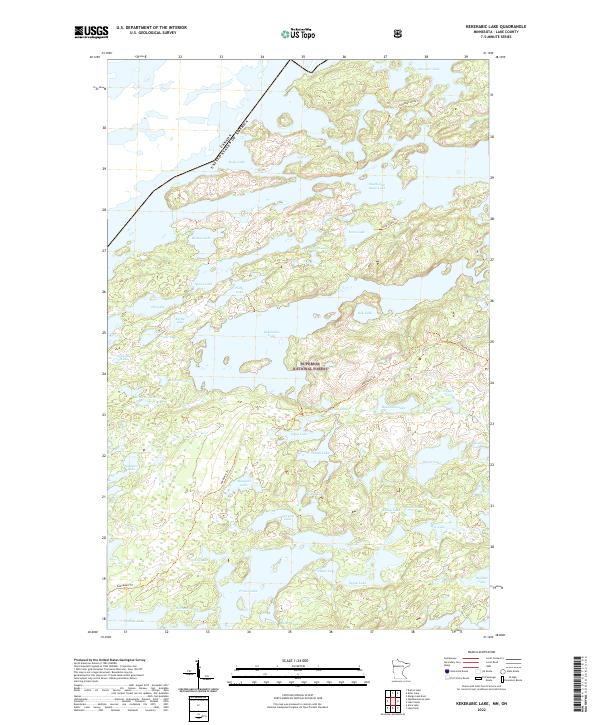
2022 Map of Kekekabic Lake
USGS Topo · Published 2022About this map
Superior National Forest encompasses this aquatic wilderness along the border of the United States and Canada. The landscape is dominated by a dense network of glacial water bodies, with the expansive Knife Lake and South Arm Knife Lake stretching across the northern sections. This topography defines a region accessible primarily by water and specialized paths, such as the Kekekabic Trl which winds through the southern half of the quadrangle.
Find a feature on this map
48 named features on this map. Tap any name to fly to it.
Don’t see what you’re looking for? This feature index may not catch every label — zoom into the map to look around manually.
Map Details
Editions of this 2022 Kekekabic Lake Map
This is the sole edition of this map. No revisions or reprints were ever made.
Other maps of this area
1954 · Two Harbors
USGS Topo · 1:250,000
1957 · Two Harbors
USGS Topo · 1:250,000
1957 · Ensign Lake
USGS Topo · 1:62,500
1957 · Quetico
USGS Topo · 1:250,000
1958 · Two Harbors
USGS Topo · 1:250,000
1959 · Ogishkemuncie Lake
USGS Topo · 1:24,000
1959 · Kekekabic Lake
USGS Topo · 1:24,000
1959 · Dutton Lake
USGS Topo · 1:24,000
1959 · Ester Lake
USGS Topo · 1:24,000
1960 · Lake Polly
USGS Topo · 1:24,000