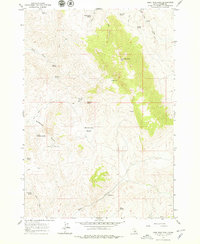
1963 Map of Lone Pine Peak
USGS Topo · Published 1979About this map
Lone Pine Peak serves as the central anchor of this high-elevation Idaho landscape, where the terrain is defined by a series of deep drainage basins and scattered water sources. The presence of Jenson Cabin Spring and Maraffo Spring suggests the historical importance of localized water for ranching or travel through this arid mountain environment. A notable geologic feature, the Petrified Forest, is located west of the peak, indicating the unique natural history preserved in the sediment of the area. Movement across the landscape in the early 1960s was primarily limited to primitive infrastructure, with a network of jeep trails and hiking trails winding through Spar Canyon and the Bradshaw Basin. The map captures a moment when the land remained largely focused on resource discovery and backcountry access, with many features like Gray Stud Spring and Sorrel Spring bearing names tied to local stock-raising heritage.
Find a feature on this map
24 named features on this map. Tap any name to fly to it.
Don’t see what you’re looking for? This feature index may not catch every label — zoom into the map to look around manually.
Map Details
Editions of this 1963 Lone Pine Peak Map
This is the sole edition of this map. No revisions or reprints were ever made.
Other maps of this area
1929 · Bayhorse
USGS Topo · 1:125,000
1957 · Challis
USGS Topo · 1:250,000
1960 · Challis
USGS Topo · 1:250,000
1963 · Challis
USGS Topo · 1:250,000
1963 · Bald Mountain
USGS Topo · 1:24,000
1963 · Bayhorse
USGS Topo · 1:24,000
1963 · Ziegler Basin
USGS Topo · 1:24,000
1963 · Little Antelope Flat
USGS Topo · 1:24,000
1963 · Clayton
USGS Topo · 1:62,500
1963 · Lone Pine Peak
USGS Topo · 1:62,500