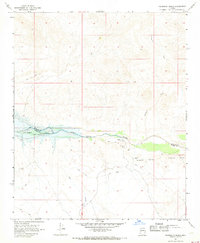
1967 Map of Palmerita Ranch
USGS Topo · Published 1969About this map
Santa Maria River valley life in the late 1960s is defined by the transition between water and desert, most notably at the Alamo Reservoir where the spillway elevation is carefully recorded. The settlement of Palmerita and the Palmerita Ranch provide a rare human footprint in this arid landscape, accompanied by a small Cem and a nearby Landing Strip. The map reveals a reliance on isolated water sources like Grapevine Springs and various unnamed wells and springs scattered along Valencia Wash and Date Creek. A network of Jeep Trails snakes through the topography, connecting an isolated Mine to the river valley. This survey captures the border region of Mohave and Yuma counties just as modern water management was reshaping the desert floor.
Find a feature on this map
14 named features on this map. Tap any name to fly to it.
Don’t see what you’re looking for? This feature index may not catch every label — zoom into the map to look around manually.
Map Details
Editions of this 1967 Palmerita Ranch Map
This is the sole edition of this map. No revisions or reprints were ever made.
Other maps of this area
1923 · Signal
USGS Topo · 1:250,000
1942 · Signal
USGS Topo · 1:250,000
1950 · Prescott
USGS Topo · 1:250,000
1954 · Prescott
USGS Topo · 1:250,000
1958 · Prescott
USGS Topo · 1:250,000
1959 · Prescott
USGS Topo · 1:250,000
1960 · Prescott
USGS Topo · 1:250,000
1965 · Prescott
USGS Topo · 1:250,000
1966 · Ives Peak
USGS Topo · 1:62,500
1966 · Artillery Peak
USGS Topo · 1:62,500