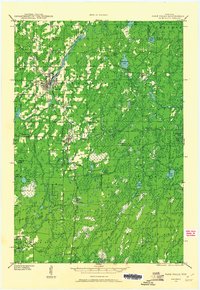
1941 Map of Park Falls
USGS Topo · Published 1961About this map
Park Falls serves as the primary hub of this north-central Wisconsin landscape, where the Flambeau River winds through Price and Ashland counties. The 1941 survey captures a rural network defined by its timber and water resources, evidenced by the Fifield Fire Tower and the Ranger Sta. Beyond the main settlements of Lymantown and Lugerville, a dense distribution of one-room schoolhouses such as Green Valley Sch, Sugarbush Sch, and Edgewood Sch suggests a once-populous backcountry before mid-century consolidation. The intersection of the Chicago and Northwestern and the Minneapolis St Paul and Sault Ste Marie railroads underscores the importance of rail transport for the region's industry and trade. Scattered throughout the Chequamegon National Forest are numerous water bodies like Sailor Lake and Solberg Lake, which hint at the region's transition toward recreation and conservation.
Find a feature on this map
66 named features on this map. Tap any name to fly to it.
Don’t see what you’re looking for? This feature index may not catch every label — zoom into the map to look around manually.
Map Details
Editions of this 1941 Park Falls Map
2 editions found
Other maps of this area
1940 · Mercer
USGS Topo · 1:48,000
1940 · Butternut
USGS Topo · 1:48,000
1941 · Park Falls
USGS Topo · 1:48,000
1941 · Pike Lake
USGS Topo · 1:48,000
1941 · Kennan
USGS Topo · 1:48,000
1941 · Kennedy
USGS Topo · 1:48,000
1941 · Phillips
USGS Topo · 1:48,000
1941 · Brantwood
USGS Topo · 1:48,000
1942 · Pike Lake
USGS Topo · 1:48,000
1942 · Glidden
USGS Topo · 1:48,000