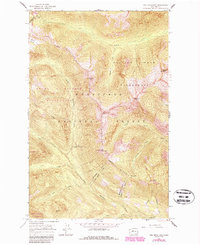
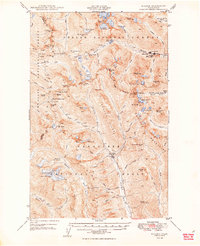
1965 Map of Poe Mountain
USGS Topo · Published 1987About this map
Poe Mountain stands as a central peak at the intersection of several high-elevation boundaries within the Wenatchee National Forest. In the mid-1960s, this landscape was defined by the transition between the Glacier Peak Wilderness and the Henry M Jackson Wilderness, with the high peaks and ridges serving as the physical dividers for drainage basins like Cady Creek and the Little Wenatchee River. The map captures the remote nature of the Cascades during this era, showing a landscape primarily accessed via trails and seasonal sites.
Find a feature on this map
36 named features on this map. Tap any name to fly to it.
Don’t see what you’re looking for? This feature index may not catch every label — zoom into the map to look around manually.
Map Details
Editions of this 1965 Poe Mountain Map
3 editions found
Other maps of this area
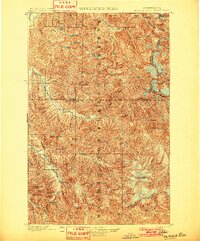
1899 · Glacier Peak
USGS Topo · 1:125,000
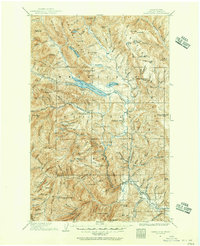
1901 · Glacier Peak
USGS Topo · 1:125,000
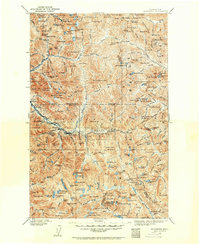
1901 · Chiwaukum
USGS Topo · 1:125,000
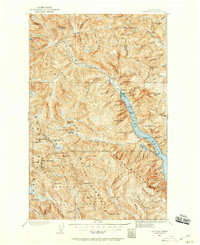
1902 · Skykomish
USGS Topo · 1:125,000
1902 · Stehekin
USGS Topo · 1:125,000
1904 · Stehekin
USGS Topo · 1:125,000
1904 · Chiwaukum
USGS Topo · 1:125,000
1905 · Skykomish
USGS Topo · 1:125,000
1944 · Holden
USGS Topo · 1:62,500
1949 · Holden
USGS Topo · 1:62,500