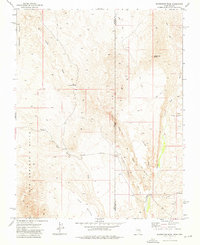
1973 Map of Scarecrow Peak
USGS Topo · Published 1976About this map
Scarecrow Peak dominates the northeastern corner of this arid landscape where the border between Utah and Nevada cuts through the desert. The 1973 survey shows a sparse network of Jeep Trail routes traversing the Tule Springs Hills, tracing the drainage patterns of Bull Valley Wash and Catclaw Wash. Water management and natural springs are the primary indicators of activity in this remote region, evidenced by Lower Lime Mtn Well and Snow Spring. To the southeast, the terrain transitions into the Terry Benches and the more defined canyon systems of Beaver Dam Wash and Indian Canyon. The map provides a precise look at the topographical challenges of the Great Basin, where seasonal washes like Little Bull Valley Wash and Horse Canyon carve deep through the limestone and volcanic layers of the high desert.
Find a feature on this map
18 named features on this map. Tap any name to fly to it.
Don’t see what you’re looking for? This feature index may not catch every label — zoom into the map to look around manually.
Map Details
Editions of this 1973 Scarecrow Peak Map
This is the sole edition of this map. No revisions or reprints were ever made.
Other maps of this area
1885 · St. George
USGS Topo · 1:250,000
1885 · Pioche
USGS Topo · 1:250,000
1886 · Pioche
USGS Topo · 1:250,000
1891 · St. George
USGS Topo · 1:250,000
1953 · Cedar City
USGS Topo · 1:250,000
1954 · Caliente
USGS Topo · 1:250,000
1958 · Cedar City
USGS Topo · 1:250,000
1959 · Caliente
USGS Topo · 1:250,000
1962 · Cedar City
USGS Topo · 1:250,000
1972 · Motoqua
USGS Topo · 1:24,000