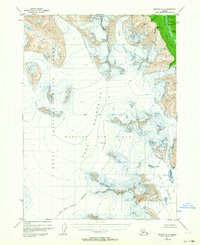
1950 Map of Seward A-8
USGS Topo · Published 1964About this map
The Harding Icefield dominates this 1950 survey, serving as a massive glacial heart from which several large frozen tongues descend into the surrounding Kenai Mountains. This frozen landscape is punctuated by numerous crevasses, particularly where the ice transitions into the Bear Glacier and Lowell Glacier. The map illustrates a harsh, high-altitude environment where the topography is defined more by ice flow and elevation than by human settlement, as evidenced by the lack of roads or trails noted in the margin.
Find a feature on this map
14 named features on this map. Tap any name to fly to it.
Don’t see what you’re looking for? This feature index may not catch every label — zoom into the map to look around manually.
Map Details
Editions of this 1950 Seward A-8 Map
This is the sole edition of this map. No revisions or reprints were ever made.
Other maps of this area
1944 · Kenai
USGS Topo · 1:250,000
1946 · Blying Sound
USGS Topo · 1:250,000
1950 · Kenai
USGS Topo · 1:250,000
1950 · Kenai B-1
USGS Topo · 1:63,360
1950 · Blying Sound D-7
USGS Topo · 1:63,360
1950 · Seward A-7
USGS Topo · 1:63,360
1951 · Blying Sound
USGS Topo · 1:250,000
1951 · Seward
USGS Topo · 1:250,000
1951 · Seldovia
USGS Topo · 1:250,000
1951 · Seward A-7
USGS Topo · 1:63,360