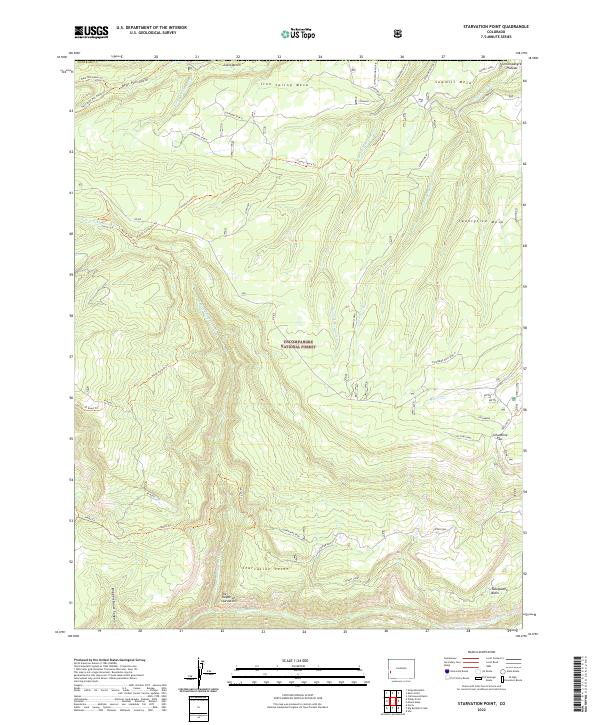
2022 Map of Starvation Point
USGS Topo · Published 2022About this map
The Uncompahgre National Forest dominates this section of the western slope, where high mesas are divided by deep canyons and a network of historic trails. The landscape is defined by massive topographic features like Iron Spring Mesa, Sawmill Mesa, and Twentyfive Mesa, which together form a high-altitude platform punctuated by the striking Starvation Point. The curiously named The Tongue of Starvation descends into the drainage of Tabeguache Cr, illustrating the isolation and harsh character of the terrain that likely informed early naming conventions.
Find a feature on this map
35 named features on this map. Tap any name to fly to it.
Don’t see what you’re looking for? This feature index may not catch every label — zoom into the map to look around manually.
Map Details
Editions of this 2022 Starvation Point Map
This is the sole edition of this map. No revisions or reprints were ever made.
Other maps of this area
1916 · Paradox Valley
USGS Topo · 1:125,000
1922 · Paradox Valley
USGS Topo · 1:125,000
1956 · Moab
USGS Topo · 1:250,000
1959 · Moab
USGS Topo · 1:250,000
1960 · Moab
USGS Topo · 1:250,000
1960 · Nucla
USGS Topo · 1:24,000
1960 · Nucla
USGS Topo · 1:62,500
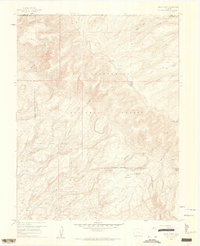
1960 · Windy Point
USGS Topo · 1:24,000
1962 · Moab
USGS Topo · 1:250,000
1964 · Moab
USGS Topo · 1:250,000