1960s Maps of Pulaski County, Illinois
Explore 11 historic maps of Pulaski County from the 1960s. These maps offer a rare glimpse into what life looked like during the 1960s — showing old roads, neighborhoods, homes, and landmarks that have changed or disappeared over time.
Whether you're researching your family's past, planning a metal detecting trip, or studying how Pulaski County's landscape evolved across the 1960s, these high-resolution maps are a powerful tool for exploring the history of this region.
- Focus on a specific era: All maps on this page are from the 1960s, giving you a focused view of this time period.
- See what’s changed: Compare century-old streets, trails, and buildings to today's modern landscape using overlays and satellite layers.
- Research with precision: Use these maps for genealogy, historical research, land use analysis, or educational projects.
- View, download, or print: Maps are fully viewable online in high resolution, and can be downloaded or printed for your own records.
Start exploring Pulaski County's history through authentic maps from the 1960s. This is your window into the past.
Pulaski County, IL maps
(11)- 1961 Map of Paducah
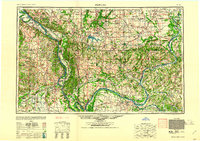 1961 Paducah1961 Print · USGSThe Lower Ohio Valley at mid-century is a landscape defined by its great rivers and newly formed reservoirs. Researchers can trace the riverfronts of Paducah and Metropolis, or locate smaller settlements like Old Shawneetown and Cave in Rock along the banks.2 unique versions available
 - 1964 Map of Paducah
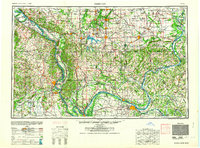 1964 Paducah1964 Print · USGSThe river-and-rail corridor of Southern Illinois and Western Kentucky is captured here during the height of the mid-century industrial era. Genealogists and researchers can trace local landmarks across several counties, from the rail yards of Paducah to the waters of Crab Orchard Lake and Kentucky Reservoir.2 unique versions available
 - 1966 Map of Karnak, 1967 Print
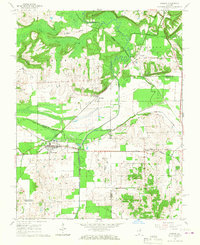 1966 Karnak1967 Print · USGSThe confluence of three counties in southern Illinois comes alive in this mid-sixties survey, showcasing a landscape defined by the drainage of the Cache River. Trace the rail lines of the New York Central through Karnak or locate family sites like Miller Cem and West Eden Ch.3 unique versions available
 - 1966 Map of Cypress, 1967 Print
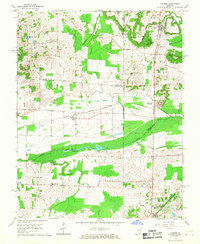 1966 Cypress1967 Print · USGSSouthern Illinois river bottoms and rail lines come alive in the mid-1960s as the Chicago and Eastern Illinois railroad threads through these three-county borderlands. Genealogists can trace family roots through sites like Masonic Cem, Century Sch, and the unique Charcoal Ovens near White Hill.
 - 1966 Map of Dongola, 1967 Print
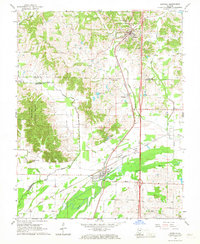 1966 Dongola1967 Print · USGSSouthern Illinois rail corridors and timberlands meet in the mid-1960s as two major lines converge near the Cache River. Genealogists can trace family landmarks like Butter Ridge Cem, Mt Pisgah Ch, and the rural community of Wetaug.3 unique versions available
 - 1966 Map of Bandana, 1968 Print
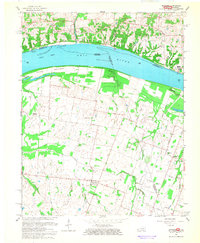 1966 Bandana1968 Print · USGSLife along the Ohio River in the 1960s centered on riverside landings and small agricultural hubs like Bandana and Monkeys Eyebrow. Researchers can trace family history through local landmarks like Ragland Sch and numerous cemeteries including Miles Cem and Hitchcock Cem.
 - 1967 Map of Cairo, 1968 Print
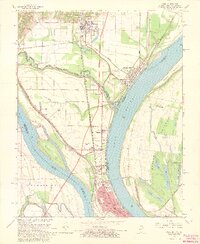 1967 Cairo1968 Print · USGSCairo and the river confluence are captured in the late sixties, showing a major rail-and-river hub at its peak. Genealogists can trace family landmarks like Lincoln Sch, Thistlewood Cemetery, and the Mound City National Cem.3 unique versions available
 - 1967 Map of Pulaski, 1968 Print
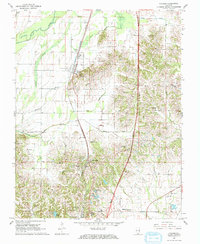 1967 Pulaski1968 Print · USGSSouthern Illinois in the late 1960s was defined by the Illinois Central rail line and the bottomlands of the Cache River. Family historians can trace rural landmarks from Old Shiloh Cem and Pryortown to True Light Ch.2 unique versions available
 - 1967 Map of Cache, 1968 Print
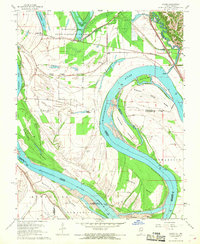 1967 Cache1968 Print · USGSThe Illinois-Missouri borderlands along the Mississippi River are captured here in the late sixties, showing a landscape shaped by river engineering and rail. Genealogists and historians can trace family-named sites like Bumgard Cem or locate the old Indian Mound near Willard.2 unique versions available
 - 1967 Map of Olmsted, 1968 Print
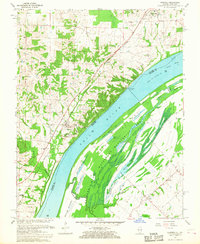 1967 Olmsted1968 Print · USGSThe Ohio River corridor comes alive in this 1960s survey of the Illinois-Kentucky border, showing the river-and-rail economy of the day. Genealogists can locate family sites like Lyerly Cem and Bethlehem Cem or trace the New York Central tracks through Olmsted.2 unique versions available
 - 1967 Map of Tamms, 1968 Print
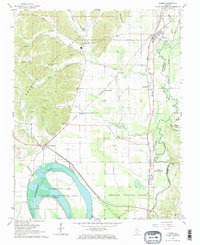 1967 Tamms1968 Print · USGSSouthern Illinois in the late sixties shows a landscape of river-bottom commerce and rail junctions near the Cache River. Genealogists and historians can trace family-named sites like Miller Cem, the Honey School, and the community of Unity.2 unique versions available
End of results
Showing maps 1-11 of 11
Top cities of Pulaski County
- Mounds historical maps
- Ullin historical maps
- Mound City historical maps
- Karnak historical maps
- Olmsted historical maps
- Pulaski historical maps
See more
Frequently asked questions
- What are the different types of historical maps available for Pulaski County?
- What is the oldest map of Pulaski County?
- Where can I purchase historical maps of Pulaski County for my home or office?
- Where can I download high-res historical maps of Pulaski County?
- Are there historical topographic maps available for Pulaski County?
- Is there historical aerial imagery available for Pulaski County?
- Where are historical maps of Pulaski County sourced from?