1940s Maps of Jefferson County, Missouri
Explore 11 historic maps of Jefferson County from the 1940s. These maps offer a rare glimpse into what life looked like during the 1940s — showing old roads, neighborhoods, homes, and landmarks that have changed or disappeared over time.
Whether you're researching your family's past, planning a metal detecting trip, or studying how Jefferson County's landscape evolved across the 1940s, these high-resolution maps are a powerful tool for exploring the history of this region.
- Focus on a specific era: All maps on this page are from the 1940s, giving you a focused view of this time period.
- See what’s changed: Compare century-old streets, trails, and buildings to today's modern landscape using overlays and satellite layers.
- Research with precision: Use these maps for genealogy, historical research, land use analysis, or educational projects.
- View, download, or print: Maps are fully viewable online in high resolution, and can be downloaded or printed for your own records.
Start exploring Jefferson County's history through authentic maps from the 1940s. This is your window into the past.
Jefferson County, MO maps
(11)- 1940 Map of Cedar Hill
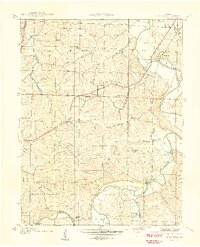 1940 Cedar Hill1940 Print · USGSJefferson County was a landscape of small river towns and hilltop schoolhouses just before the 1940s. Genealogists and local historians can trace family roots through landmarks like St Martins Ch, Morse Mill, and the many rural schools including Bethlehem Sch.
 - 1940 Map of Kirkwood
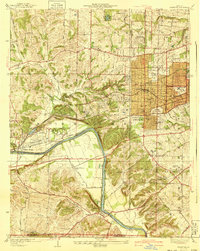 1940 Kirkwood1940 Print · USGSSt. Louis County shows its rapid suburban and institutional growth before the mid-century boom. Genealogists and historians can trace the rail-centered development of Kirkwood and find vanished landmarks like Windsor Springs and Hartman College.3 unique versions available
 - 1940 Map of Renault, 1955 Print
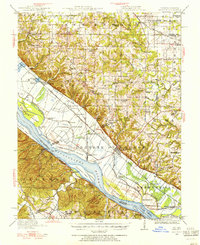 1940 Renault1955 Print · USGSThe Illinois-Missouri borderlands come to life in the 1940s, highlighting the river-driven economy and rural community structure of the Mississippi valley. Genealogists can trace family footprints through dozens of local landmarks, from the Ruma Convent to historic schoolhouses like Yankeetown School and Foster School.2 unique versions available
 - 1945 Map of Manchester, 1955 Print
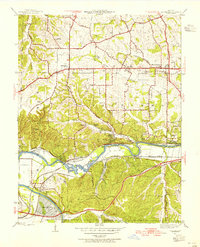 1945 Manchester1955 Print · USGSWestern St. Louis County is shown at a pivotal moment in the 1940s as suburban growth began to meet rural river life. Genealogists and historians can trace old homesteads and landmarks like Times Beach, Sherman P O, and the Sulphur Springs Sch.
 - 1946 Map of Richwoods, 1957 Print
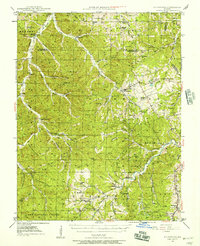 1946 Richwoods1957 Print · USGSThe Missouri Ozarks are captured here at the end of the Second World War, showing the rural communities of Washington County. Genealogists can locate family-named landmarks and institutions like Old Mines, Souls Chapel, and the Ebo Sch schoolhouse.3 unique versions available
 - 1947 Map of Manchester
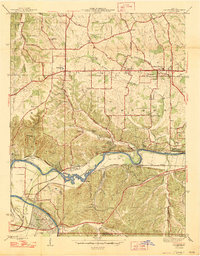 1947 Manchester1947 Print · USGSSt. Louis County is captured here just after the war, showing the distinct identities of communities along the historic Manchester Road. Genealogists and historians can locate family landmarks like the Ranken Cem, several local schoolhouses, and the original street grid of Times Beach.2 unique versions available
 - 1947 Map of St. Clair, 1950 Print
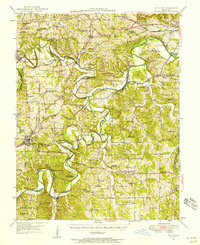 1947 St. Clair1950 Print · USGSFranklin County at the dawn of the fifties shows a landscape shaped by the winding Meramec River and a busy network of major railroads. Genealogists and local historians can locate early landmarks like Purina Farm, the Virginia Mines (Abandoned), and the Brush Creek Cem.3 unique versions available
 - 1948 Map of Richwoods
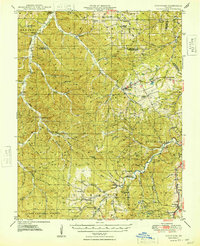 1948 Richwoods1948 Print · USGSIn the mid-1940s, this area of Washington County remained a landscape of rural schoolhouses and family-named hollows. Researchers can trace the layout of early communities like Richwoods, locate the historic Souls Chapel, or find remote school sites such as Hulsey Sch and Clifton Sch.
 - 1948 Map of Kimmswick, 1955 Print
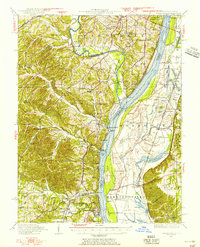 1948 Kimmswick1955 Print · USGSThe Mississippi River corridor south of St. Louis appears here at a mid-century peak of rail and river industry. Researchers can trace historic river landings and rural schools like Harrisonville Landing, Blue Church, and the sprawling grounds of Jefferson Barracks.
 - 1949 Map of Saint Louis
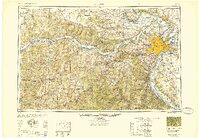 1949 Saint Louis1949 Print · USGSGreater St. Louis and its surrounding river valleys are captured here just after the war, showing the metropolitan core and the rural Ozark fringe. Researchers can trace the sprawling rail network of the Wabash RR or locate landmarks like Meramec Caverns Airport and Scott Air Force Base.2 unique versions available
 - 1949 Map of Crystal City, 1959 Print
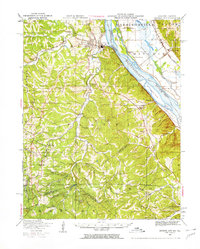 1949 Crystal City1959 Print · USGSThe Mississippi River valley comes alive in the late 1940s, showing the industrial pulse of Festus and the rural reaches of Jefferson County. Genealogists can locate numerous vanished landmarks like the Telegraph School, Valle Mines, and the Rush Tower river landing.2 unique versions available
End of results
Showing maps 1-11 of 11
Frequently asked questions
- What are the different types of historical maps available for Jefferson County?
- What is the oldest map of Jefferson County?
- Where can I purchase historical maps of Jefferson County for my home or office?
- Where can I download high-res historical maps of Jefferson County?
- Are there historical topographic maps available for Jefferson County?
- Is there historical aerial imagery available for Jefferson County?
- Where are historical maps of Jefferson County sourced from?