1950s Maps of Jefferson County, Missouri
Explore 15 historic maps of Jefferson County from the 1950s. These maps offer a rare glimpse into what life looked like during the 1950s — showing old roads, neighborhoods, homes, and landmarks that have changed or disappeared over time.
Whether you're researching your family's past, planning a metal detecting trip, or studying how Jefferson County's landscape evolved across the 1950s, these high-resolution maps are a powerful tool for exploring the history of this region.
- Focus on a specific era: All maps on this page are from the 1950s, giving you a focused view of this time period.
- See what’s changed: Compare century-old streets, trails, and buildings to today's modern landscape using overlays and satellite layers.
- Research with precision: Use these maps for genealogy, historical research, land use analysis, or educational projects.
- View, download, or print: Maps are fully viewable online in high resolution, and can be downloaded or printed for your own records.
Start exploring Jefferson County's history through authentic maps from the 1950s. This is your window into the past.
Jefferson County, MO maps
(15)- 1950 Map of St. Clair
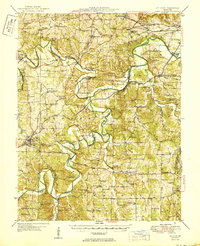 1950 St. Clair1950 Print · USGSFranklin County's winding river valleys and ridge-top settlements are captured here in the mid-twentieth century. Genealogists and local historians can trace family locations near Virginia Mines, the Henry Shaw Arboretum, and numerous rural schools like Ten Tiney Bluff Sch.
 - 1954 Map of House Springs, 1956 Print
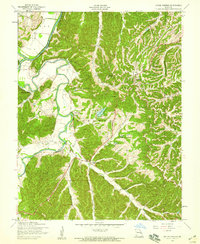 1954 House Springs1956 Print · USGSJefferson County in the mid-1950s is a landscape of winding river valleys and ridge-top settlements. Researchers can trace the development of High Ridge and House Springs or locate family landmarks like Byrnes Mill, Hoene Spring, and St Martins Ch.8 unique versions available
 - 1954 Map of Kirkwood, 1959 Print
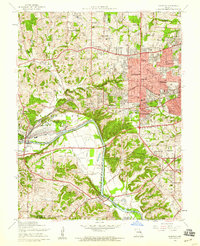 1954 Kirkwood1959 Print · USGSPost-war St. Louis County suburbs expand across the Meramec River valley in the mid-fifties as new neighborhoods surround historic rail lines. Genealogists can trace family roots at Marshall Cem or explore sites like Weiss Airport and Ursuline Academy.7 unique versions available
 - 1954 Map of Oakville, 1959 Print
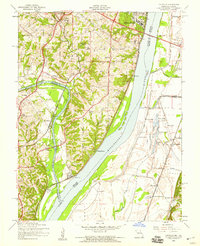 1954 Oakville1959 Print · USGSThe confluence of the Meramec and Mississippi rivers comes into focus during the mid-fifties, showing the growth of St. Louis County and the Illinois bottomlands. Researchers can trace the grounds of Jefferson Barracks, locate family plots at St Pauls Cem, or find long-standing community landmarks like Nazareth Convent.4 unique versions available
 - 1954 Map of Belew Creek, 1959 Print
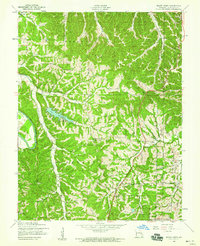 1954 Belew Creek1959 Print · USGSJefferson County hills in the mid-1950s are defined by winding waterways and ridge-top settlements. Genealogists can trace the rural landscape around Lake Tishomingo, Goldman, and local landmarks like Glade Chapel and the Lookout Tower.5 unique versions available
 - 1954 Map of Manchester, 1959 Print
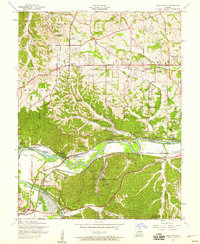 1954 Manchester1959 Print · USGSThe Meramec valley and western St. Louis County are seen here in the mid-fifties, during a period of suburban expansion and industrial utility. Genealogists can locate family landmarks like Lewis Cem, the Oak Ridge Sch (Abandoned), and the original platting of Times Beach.8 unique versions available
 - 1954 Map of Maxville, 1959 Print
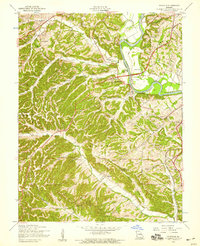 1954 Maxville1959 Print · USGSJefferson County and the St. Louis border are shown here during the mid-fifties, just as rural valley life met new transportation growth. Genealogists can locate family landmarks like McCormack Cem, Bowles Sch, and the winding Lemay Ferry Road.5 unique versions available
 - 1954 Map of Pacific, 1959 Print
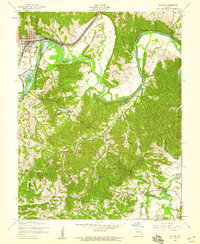 1954 Pacific1959 Print · USGSThe Meramec River valley in the mid-fifties remains a world of winding rail lines and rural parishes. Genealogists can trace family footprints at St Stephens Ch, Byrnesville, and the grounds of the St Josephs Hill Infirmary.5 unique versions available
 - 1954 Map of Herculaneum, 1959 Print
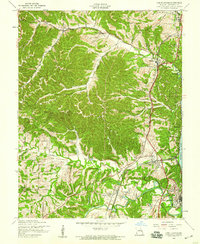 1954 Herculaneum1959 Print · USGSJefferson County in the mid-1950s shows a landscape shaped by river commerce and the rugged bluffs of the Mississippi River. Genealogists and researchers can trace family landmarks like Mahler Cem, St Lukes Ch, and the early footprints of Herculaneum and Pevely.4 unique versions available
 - 1954 Map of Valmeyer, 1959 Print
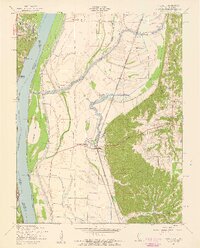 1954 Valmeyer1959 Print · USGSThe Illinois-Missouri borderlands in the mid-1950s showcase a landscape of river-bottom farms and bluff-side hollows along the Mississippi River. Researchers can trace old rail lines like the Missouri Pacific and find vanished rural schools including Central Sch and Miles Prairie Sch.4 unique versions available
 - 1954 Map of Cedar Hill, 1959 Print
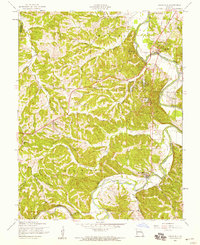 1954 Cedar Hill1959 Print · USGSThe Big River valley of Jefferson County is captured here in the mid-fifties, showing the rural communities before suburban expansion. Researchers can find many lost local landmarks, including Maple Grove Sch, the 101 Ranch, and Skullers Cem.5 unique versions available
 - 1954 Map of Kimmswick, 1960 Print
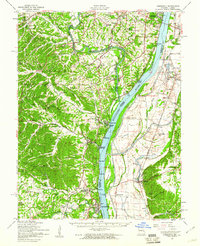 1954 Kimmswick1960 Print · USGSThe Mississippi River corridor south of St. Louis comes to life in the mid-fifties, showing the rail-dependent towns of Kimmswick and Herculaneum. Genealogists and historians can trace family landmarks like Richardson Cem, Point Sch, and Harrisonville Landing.2 unique versions available
 - 1955 Map of De Soto NE
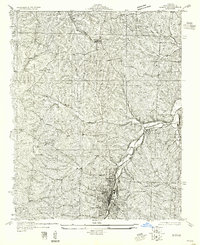 1955 De Soto NE1955 Print · USGSJefferson County's rural character is preserved here in the mid-1950s, showing the early infrastructure connecting local rail hubs. Family historians can locate a dense network of country schools like Buckie Sch and New Hope Sch along the banks of Joachim Creek.
 - 1955 Map of De Soto SE
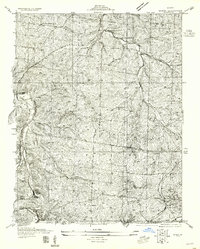 1955 De Soto SE1955 Print · USGSJefferson and St. Francois counties in the early thirties reveal a landscape of ridge-top schools and river-valley railroads. Genealogists can trace family names at Joachim Cem or locate the old Tunnel Sta and Silver Springs Sta along the rail lines.
 - 1958 Map of De Soto NE
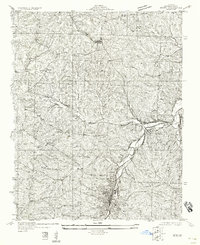 1958 De Soto NE1958 Print · USGSJefferson County during the early twentieth century shows a landscape defined by rail and creek valleys. Genealogists and local historians can trace the foundations of Festus and Hematite or locate rural landmarks like Haverstick Sch and the Missouri Pacific line.
End of results
Showing maps 1-15 of 15
Frequently asked questions
- What are the different types of historical maps available for Jefferson County?
- What is the oldest map of Jefferson County?
- Where can I purchase historical maps of Jefferson County for my home or office?
- Where can I download high-res historical maps of Jefferson County?
- Are there historical topographic maps available for Jefferson County?
- Is there historical aerial imagery available for Jefferson County?
- Where are historical maps of Jefferson County sourced from?