1900s (20th Century) Maps of Forks of Blue Creek, Tennessee
Explore 5 historic maps of Forks of Blue Creek from the 1900s (20th Century). These maps offer a rare glimpse into what life looked like during the 1900s — showing old roads, neighborhoods, homes, and landmarks that have changed or disappeared over time.
Whether you're researching your family's past, planning a metal detecting trip, or studying how Forks of Blue Creek's landscape evolved across the 1900s, these high-resolution maps are a powerful tool for exploring the history of this region.
- Focus on a specific era: All maps on this page are from the 1900s, giving you a focused view of this time period.
- See what’s changed: Compare century-old streets, trails, and buildings to today's modern landscape using overlays and satellite layers.
- Research with precision: Use these maps for genealogy, historical research, land use analysis, or educational projects.
- View, download, or print: Maps are fully viewable online in high resolution, and can be downloaded or printed for your own records.
Start exploring Forks of Blue Creek's history through authentic maps from the 1900s. This is your window into the past.
Forks of Blue Creek, TN maps
(5)- 1936 Map of Gorman
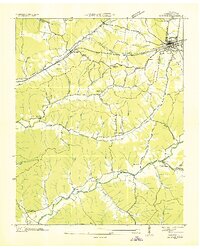 1936 Gorman1936 Print · USGSHumphreys County appears in transition during the mid-1930s as modern power lines and rail networks began to reshape this rural landscape. Genealogists and researchers can trace family landmarks and community centers like Bennyfield Cem, Bethel Ch, and Wallace Sch.
 - 1952 Map of Mc Ewen, 1957 Print
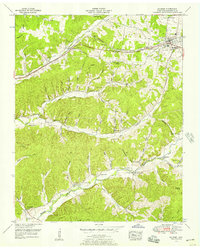 1952 Mc Ewen1957 Print · USGSMcEwen and the surrounding Humphreys County hollows are captured here in the early 1950s as a landscape of small farms and family cemeteries. Trace the path of the Nashville Chattanooga and St Louis Railway and find landmarks like Liberty Sch or McCandless Bridge.3 unique versions available
 - 1956 Map of Nashville, 1971 Print
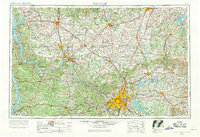 1956 Nashville1971 Print · USGSThe Tennessee-Kentucky borderlands come into focus in the mid-1960s as major reservoir projects transformed the Cumberland and Tennessee river valleys. Researchers can trace the rail networks of the Louisville and Nashville and visit sites like Fort Campbell and Fort Donelson National Military Park.2 unique versions available
 - 1959 Map of Nashville
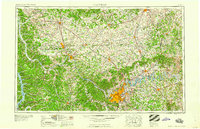 1959 Nashville1959 Print · USGSMiddle Tennessee and Southern Kentucky come into focus during the late fifties, showing the region's transition into a modern transportation and military hub. Researchers can trace the sprawling Fort Campbell Military Reservation or locate historic rail stops along the Tennessee Central Ry and Illinois Central RR.
 - 1985 Map of Dickson
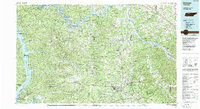 1985 Dickson1985 Print · USGSMid-Tennessee in the mid-1980s was defined by the intersection of the Cumberland and Tennessee rivers and a massive network of wildlife refuges. Researchers can trace the Seaboard System rail lines connecting Waverly, Dickson, and White Bluff, or locate old landmarks near Fort Donelson National Military Park.
End of results
Showing maps 1-5 of 5
Top cities near Forks of Blue Creek
- Waverly historical maps
- Camden historical maps
- Centerville historical maps
- New Johnsonville historical maps
Frequently asked questions
- What are the different types of historical maps available for Forks of Blue Creek?
- What is the oldest map of Forks of Blue Creek?
- Where can I purchase historical maps of Forks of Blue Creek for my home or office?
- Where can I download high-res historical maps of Forks of Blue Creek?
- Are there historical topographic maps available for Forks of Blue Creek?
- Is there historical aerial imagery available for Forks of Blue Creek?
- Where are historical maps of Forks of Blue Creek sourced from?