1950s Maps of Erath County, Texas
Explore 12 historic maps of Erath County from the 1950s. These maps offer a rare glimpse into what life looked like during the 1950s — showing old roads, neighborhoods, homes, and landmarks that have changed or disappeared over time.
Whether you're researching your family's past, planning a metal detecting trip, or studying how Erath County's landscape evolved across the 1950s, these high-resolution maps are a powerful tool for exploring the history of this region.
- Focus on a specific era: All maps on this page are from the 1950s, giving you a focused view of this time period.
- See what’s changed: Compare century-old streets, trails, and buildings to today's modern landscape using overlays and satellite layers.
- Research with precision: Use these maps for genealogy, historical research, land use analysis, or educational projects.
- View, download, or print: Maps are fully viewable online in high resolution, and can be downloaded or printed for your own records.
Start exploring Erath County's history through authentic maps from the 1950s. This is your window into the past.
Erath County, TX maps
(12)- 1954 Map of Brownwood, 1955 Print
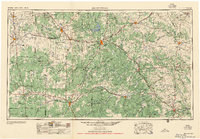 1954 Brownwood1955 Print · USGSCentral Texas in the early fifties shows a landscape of rail-linked cattle towns and winding river valleys before modern highway expansion. Genealogists and historians can trace family-named peaks and vanished rail stops like Trickham, Santa Anna, and the Brady Mountains.3 unique versions available
 - 1954 Map of Dallas, 1963 Print
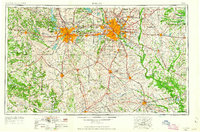 1954 Dallas1963 Print · USGSNorth Texas in the mid-fifties and early sixties reveals a landscape of rapid urban growth and water management. Genealogists and historians can trace the evolution of the metroplex through landmarks like Hensley Field, Boles Orphan Home, and the Texas & Pacific RR.4 unique versions available
 - 1954 Map of Abilene, 1966 Print
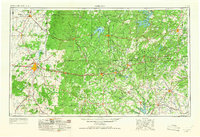 1954 Abilene1966 Print · USGSThe Texas Big Country comes into focus in the mid-1950s as petroleum and new water projects reshape the landscape. Local historians can trace the Butterfield Trail, find the Fort Phantom Hill Ruins, and locate numerous small communities along the Texas & Pacific line.2 unique versions available
 - 1956 Map of Gustine
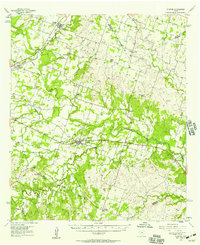 1956 Gustine1956 Print · USGSMid-century Comanche County is seen here just as the highway network was being formalized around the Leon River valley. Genealogists can trace family names through numerous rural sites like Graham Chapel Cem, Energy Sch, and the town of Gustine.
 - 1956 Map of Hico, 1957 Print
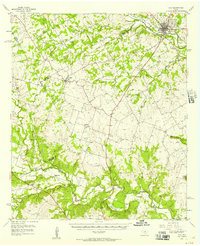 1956 Hico1957 Print · USGSThe Bosque River valley and the railroad town of Hico are shown here in the mid-fifties, capturing a landscape of small farming communities and historic routes. Genealogists can locate numerous rural burial sites like Tillinghouse Cem and the Springtown (Site of).2 unique versions available
 - 1956 Map of Edna Hill, 1957 Print
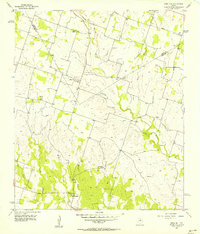 1956 Edna Hill1957 Print · USGSTexas ranching country along the Erath and Comanche county line comes to life in the mid-1950s. Researchers can locate the settlement and church at Hazeldell, find family burials at Barbee Cemetery, and trace the winding paths of Resley Creek and Joplin Creek.2 unique versions available
 - 1956 Map of Carlton, 1957 Print
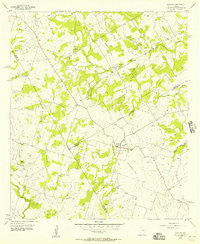 1956 Carlton1957 Print · USGSThe rural landscape of the Hamilton and Comanche County borders is captured here in the mid-fifties, centered on the community of Carlton. Genealogists and historians can trace family-named sites like Turnbow Cemetery, the local High Sch, and the path of an Old Railroad Grade.3 unique versions available
 - 1956 Map of Hico, 1957 Print
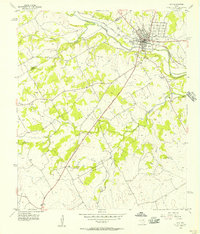 1956 Hico1957 Print · USGSHico and the surrounding North Texas ranching country are captured here in the mid-1950s, highlighting the intersection of rail and river commerce. Family historians can locate several rural burial sites like Honey Creek Cem and Dry Fork Cem, or trace the path of the Texas and Missouri Kansas railroad.2 unique versions available
 - 1958 Map of Dallas
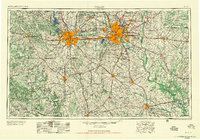 1958 Dallas1958 Print · USGSNorth Texas in the late fifties shows the dramatic expansion of the Metroplex as it absorbs surrounding farm towns. Genealogists and historians can trace old rail lines like the Missouri-Kansas-Texas and locate early lakefront developments at Eagle Mountain Lake and Lake Worth Village.
 - 1958 Map of Abilene
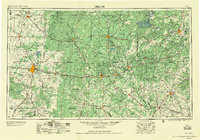 1958 Abilene1958 Print · USGSMid-century West Texas comes alive in this survey of the Abilene and Stephenville region during a period of steady oil expansion and military growth. Genealogists and local historians can trace the paths of the Texas & Pacific RR through historic towns, locate the Fort Griffin Ruins, and find smaller settlements like Desdemona and Lueders.
 - 1959 Map of Lipan, 1960 Print
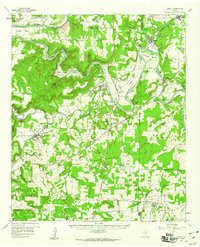 1959 Lipan1960 Print · USGSNear the intersection of four Texas counties in the late fifties, this survey captures the rural character and winding river bends of the Brazos valley. Researchers can locate family landmarks like Evergreen Cem, Dobbs Valley Ch, and the remote Progress Sch.3 unique versions available
 - 1959 Map of Gordon, 1960 Print
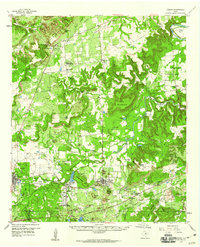 1959 Gordon1960 Print · USGSThe Palo Pinto hills in the late fifties show a landscape defined by the Texas and Pacific railroad and active coal and oil extraction. Local researchers can trace the locations of family burial sites like Thurber Cem and landmarks like Metcalf Gap.2 unique versions available
End of results
Showing maps 1-12 of 12
Top cities of Erath County
- Stephenville historical maps
- Dublin historical maps
- Stephenville Country Club Lake historical maps
- Thurber historical maps
Frequently asked questions
- What are the different types of historical maps available for Erath County?
- What is the oldest map of Erath County?
- Where can I purchase historical maps of Erath County for my home or office?
- Where can I download high-res historical maps of Erath County?
- Are there historical topographic maps available for Erath County?
- Is there historical aerial imagery available for Erath County?
- Where are historical maps of Erath County sourced from?