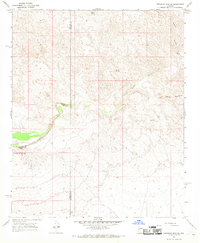
1967 Map of Arrastra Mtn SE
USGS Topo · Published 1969About this map
The Santa Maria River snakes through this high desert landscape, serving as a vital hydrologic corridor and a natural boundary between Mohave, Yavapai, and Yuma Counties. This late-1960s survey documents the isolated mining and ranching infrastructure of western Arizona, highlighted by the Anderson Mine and another unnamed mine situated in the foothills of the Black Mountains. The reliance on scarce water sources is evident in the scattered locations of Sams Spring, Burro Spring, and Grapevine Springs. Along the river's path, a Gaging Station monitors the flow through this arid terrain. The map's detail provides a record of the unimproved dirt roads that connected these remote mineral claims and water holes during a period of continued geological exploration in the region.
Find a feature on this map
14 named features on this map. Tap any name to fly to it.
Don’t see what you’re looking for? This feature index may not catch every label — zoom into the map to look around manually.
Map Details
Editions of this 1967 Arrastra Mtn SE Map
This is the sole edition of this map. No revisions or reprints were ever made.
Other maps of this area
1923 · Signal
USGS Topo · 1:250,000
1942 · Signal
USGS Topo · 1:250,000
1950 · Prescott
USGS Topo · 1:250,000
1954 · Prescott
USGS Topo · 1:250,000
1958 · Prescott
USGS Topo · 1:250,000
1959 · Prescott
USGS Topo · 1:250,000
1960 · Prescott
USGS Topo · 1:250,000
1965 · Prescott
USGS Topo · 1:250,000
1967 · Date Creek Ranch NW
USGS Topo · 1:24,000
1967 · Palmerita Ranch
USGS Topo · 1:24,000