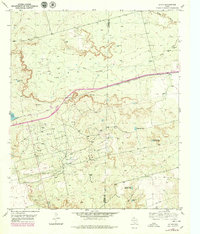
1951 Map of Iatan
USGS Topo · Published 1979About this map
The Howard County and Mitchell County line bisects this landscape, dominated by the industrial and transport corridors that define West Texas. The Pacific and Missouri railroad lines run parallel across the central plains, passing through the settlement of Iatan. This era of mapping shows a landscape of resource extraction and water management, evidenced by the extensive Tank Farm in the south and various industrial landmarks like the Caliche Pit. Water features are critical in this arid terrain, with Iatan Lake and several man-made reservoirs including California Tank and Watson Tank providing necessary infrastructure. Topographically, the land transitions from the Flat S plains to the more varied relief near Rattlesnake Gap, while numerous windmills and pipe lines crisscross the territory, serving the needs of the local cattle and oil economies.
Find a feature on this map
23 named features on this map. Tap any name to fly to it.
Don’t see what you’re looking for? This feature index may not catch every label — zoom into the map to look around manually.
Map Details
Editions of this 1951 Iatan Map
This is the sole edition of this map. No revisions or reprints were ever made.
Other maps of this area
1941 · Big Spring South
USGS Topo · 1:62,500
1942 · Big Spring South
USGS Topo · 1:62,500
1942 · Big Spring North
USGS Topo · 1:62,500
1951 · Vincent
USGS Topo · 1:24,000
1952 · Iatan
USGS Topo · 1:24,000
1952 · Cuthbert
USGS Topo · 1:24,000
1952 · Westbrook
USGS Topo · 1:24,000
1954 · Big Spring
USGS Topo · 1:250,000
1954 · Big Spring North NE
USGS Topo · 1:24,000
1958 · Big Spring
USGS Topo · 1:250,000