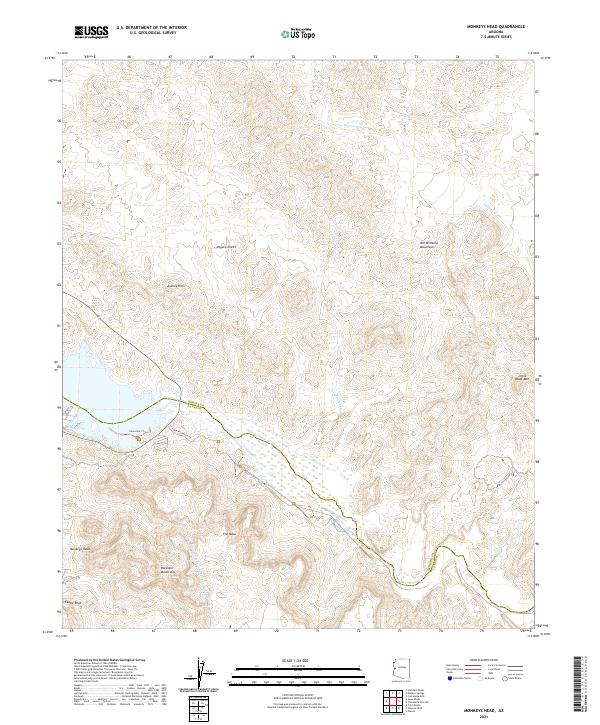
2021 Map of Monkeys Head
USGS Topo · Published 2021About this map
The Bill Williams River carves a critical path through this arid landscape, serving as the border between Mohave and La Paz counties. This 2021 survey illustrates the complex water management systems of the American West, featuring the Central Arizona Project Aqueduct as it traverses the southern reach of the Mojave Desert. The terrain is defined by distinct topographical rises including the Aubrey Hills to the north and the Buckskin Mountains to the south.
Find a feature on this map
22 named features on this map. Tap any name to fly to it.
Don’t see what you’re looking for? This feature index may not catch every label — zoom into the map to look around manually.
Map Details
Editions of this 2021 Monkeys Head Map
This is the sole edition of this map. No revisions or reprints were ever made.
Other maps of this area
1911 · Parker
USGS Topo · 1:125,000
1923 · Signal
USGS Topo · 1:250,000
1942 · Signal
USGS Topo · 1:250,000
1943 · Giers Basin
USGS Topo · 1:62,500
1950 · Parker Dam Area
USGS Topo · 1:62,500
1950 · Prescott
USGS Topo · 1:250,000
1954 · Needles
USGS Topo · 1:250,000
1954 · Prescott
USGS Topo · 1:250,000
1956 · Needles
USGS Topo · 1:250,000
1958 · Prescott
USGS Topo · 1:250,000