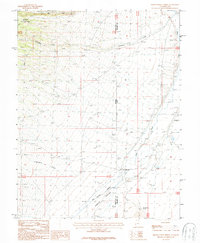
1987 Map of Needle Point Spring
USGS Topo · Published 1987About this map
Burbank sits at the nexus of several vital water sources in this high-desert landscape on the border of Utah and Nevada. The map details the drainage patterns of Hamlin Valley, where ephemeral and perennial flows like Big Springs Creek and Lexington Creek converge near the settlement. The presence of Needle Point Spring and a small Cem reflect the sparse but enduring human presence in this arid region during the late twentieth century. To the northwest, the boundary of the Humboldt National Forest marks a transition in land use, while a solitary Gravel Pit and scattered wells suggest local industrial and ranching activity. The terrain is defined by dry washes such as Big Wash and the distinct topographic rise at Chokecherry, providing a clear record of the hydrologic and geologic character of the Millard County and White Pine County line.
Find a feature on this map
14 named features on this map. Tap any name to fly to it.
Don’t see what you’re looking for? This feature index may not catch every label — zoom into the map to look around manually.
Map Details
Editions of this 1987 Needle Point Spring Map
This is the sole edition of this map. No revisions or reprints were ever made.
Other maps of this area
1949 · Garrison
USGS Topo · 1:62,500
1951 · Garrison
USGS Topo · 1:62,500
1953 · Richfield
USGS Topo · 1:250,000
1956 · Lund
USGS Topo · 1:250,000
1958 · Richfield
USGS Topo · 1:250,000
1960 · Lund
USGS Topo · 1:250,000
1960 · Burbank Hills
USGS Topo · 1:62,500
1971 · Mormon Gap
USGS Topo · 1:24,000
1972 · Tweedy Wash
USGS Topo · 1:24,000
1972 · Big Springs
USGS Topo · 1:24,000