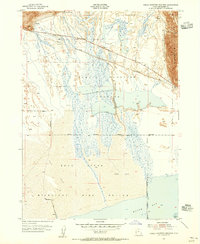
1954 Map of Public Shooting Grounds
USGS Topo · Published 1956About this map
The Bear River delta and the marshy margins of the Great Salt Lake are captured here in the mid-1950s, revealing a landscape defined by water management and migratory patterns. The Bear River Migratory Bird Refuge and Public Shooting Grounds Refuge dominate the terrain, where an intricate network of levees and embankments control the flow across the Mud Flat and Salt Flat. To the north, the path of the Old Railroad Grade cuts a straight line across the wetlands, marking the historical corridor of the transcontinental rail route before its realignment. Natural features like Connor Springs and the winding channel of Mollys Stocking provide freshwater contrast to the brackish expanse of North Bay. This map is particularly valuable for its record of early conservation infrastructure and the physical remains of the original steam-era rail infrastructure near the shores of the lake.
Find a feature on this map
19 named features on this map. Tap any name to fly to it.
Don’t see what you’re looking for? This feature index may not catch every label — zoom into the map to look around manually.
Map Details
Editions of this 1954 Public Shooting Grounds Map
This is the sole edition of this map. No revisions or reprints were ever made.
Other maps of this area
1954 · Whistler Canal
USGS Topo · 1:24,000
1954 · Brigham City
USGS Topo · 1:250,000
1955 · Mouth of Bear River
USGS Topo · 1:24,000
1955 · Bear River City
USGS Topo · 1:24,000
1958 · Brigham City
USGS Topo · 1:250,000
1961 · Thatcher Mountain
USGS Topo · 1:62,500
1961 · Tremonton
USGS Topo · 1:24,000
1962 · Brigham City
USGS Topo · 1:250,000
1966 · Thatcher Mountain SW
USGS Topo · 1:24,000
1967 · East Promontory
USGS Topo · 1:24,000