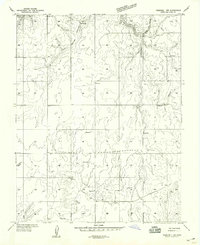
1959 Map of Verdure 1 NW
USGS Topo · Published 1959About this map
Dry Farm stands as a notable human mark on this high desert plateau in San Juan County, reflecting the agricultural adaptation required in such an arid environment. This 1957 mapping effort captures a landscape defined by its hydrology, where numerous unnamed reservoirs were constructed to catch and hold seasonal runoff across the terrain. These man-made features sit in contrast to natural drainage systems like Iron Spring and the winding depths of Spring Canyon. The map reveals the infrastructure of the late 1950s, including a prominent industrial Pipeline cutting across the northeastern corner. The relief is further shaped by the steep descents into East Canyon and Bear Trap Canyon, illustrating the complex topography that governed movement and settlement in this corner of southeastern Utah.
Find a feature on this map
7 named features on this map. Tap any name to fly to it.
Don’t see what you’re looking for? This feature index may not catch every label — zoom into the map to look around manually.
Map Details
Editions of this 1959 Verdure 1 NW Map
This is the sole edition of this map. No revisions or reprints were ever made.
Other maps of this area
1885 · La Sal
USGS Topo · 1:250,000
1886 · Abajo
USGS Topo · 1:250,000
1892 · Abajo
USGS Topo · 1:250,000
1893 · Abajo
USGS Topo · 1:250,000
1954 · Mt Peale 3 SE
USGS Topo · 1:24,000
1954 · Mt Peale 4 SE
USGS Topo · 1:24,000
1954 · Mt Peale 4 SW
USGS Topo · 1:24,000
1954 · Lisbon Valley
USGS Topo · 1:62,500
1954 · Hatch Rock
USGS Topo · 1:62,500
1955 · Verdure 2 SE
USGS Topo · 1:24,000