1950s Maps of Red Oak, Texas
Explore 6 historic maps of Red Oak from the 1950s. These maps offer a rare glimpse into what life looked like during the 1950s — showing old roads, neighborhoods, homes, and landmarks that have changed or disappeared over time.
Whether you're researching your family's past, planning a metal detecting trip, or studying how Red Oak's landscape evolved across the 1950s, these high-resolution maps are a powerful tool for exploring the history of this region.
- Focus on a specific era: All maps on this page are from the 1950s, giving you a focused view of this time period.
- See what’s changed: Compare century-old streets, trails, and buildings to today's modern landscape using overlays and satellite layers.
- Research with precision: Use these maps for genealogy, historical research, land use analysis, or educational projects.
- View, download, or print: Maps are fully viewable online in high resolution, and can be downloaded or printed for your own records.
Start exploring Red Oak's history through authentic maps from the 1950s. This is your window into the past.
Red Oak, TX maps
(6)- 1954 Map of Dallas, 1963 Print
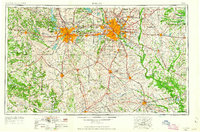 1954 Dallas1963 Print · USGSNorth Texas in the mid-fifties and early sixties reveals a landscape of rapid urban growth and water management. Genealogists and historians can trace the evolution of the metroplex through landmarks like Hensley Field, Boles Orphan Home, and the Texas & Pacific RR.4 unique versions available
 - 1956 Map of Ennis
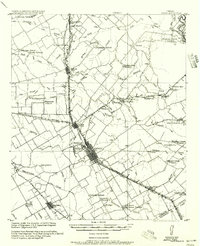 1956 Ennis1956 Print · USGSEllis County agricultural life is captured here in the years following the first World War, centered on the rail crossroads at Ennis P.O. Genealogists can locate family landmarks like Ghost School, Antioch Church, and the settlement of Boyce (Cottonwood).
 - 1958 Map of Dallas
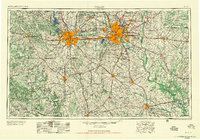 1958 Dallas1958 Print · USGSNorth Texas in the late fifties shows the dramatic expansion of the Metroplex as it absorbs surrounding farm towns. Genealogists and historians can trace old rail lines like the Missouri-Kansas-Texas and locate early lakefront developments at Eagle Mountain Lake and Lake Worth Village.
 - 1959 Map of Lancaster, 1960 Print
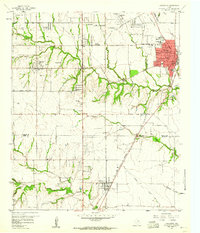 1959 Lancaster1960 Print · USGSSouthern Dallas County and northern Ellis County are shown here in the late fifties, as traditional farming communities began to expand. You can locate family history at Rawlins Cem, trace the Missouri Kansas Texas Railroad corridor, and find old landmarks like Camp Pinkston or Beckley City Chapel.5 unique versions available
 - 1959 Map of Ferris, 1960 Print
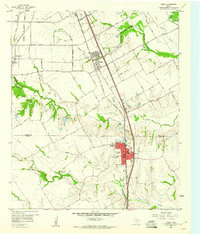 1959 Ferris1960 Print · USGSThe northern Ellis County borderlands and southern Dallas County come alive in the late fifties, showing the rail-centered growth of Ferris and Wilmer. Researchers can trace old family sites near Bluff Springs Cemetery or the Dunbar High School.3 unique versions available
 - 1959 Map of Seagoville, 1962 Print
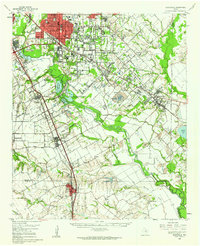 1959 Seagoville1962 Print · USGSSoutheast of Dallas in the late fifties, the Trinity River valley served as a busy corridor of railroads and growing townships. Trace family roots at Sand Branch Cem, locate the Hutchins Boys Industrial Sch, and explore the winding Parsons Slough.
End of results
Showing maps 1-6 of 6
Top cities near Red Oak
- Dallas historical maps
- Grand Prairie historical maps
- Mesquite historical maps
- DeSoto historical maps
- De Soto historical maps
- Cedar Hill historical maps
See more
Top neighborhoods of Red Oak
Frequently asked questions
- What are the different types of historical maps available for Red Oak?
- What is the oldest map of Red Oak?
- Where can I purchase historical maps of Red Oak for my home or office?
- Where can I download high-res historical maps of Red Oak?
- Are there historical topographic maps available for Red Oak?
- Is there historical aerial imagery available for Red Oak?
- Where are historical maps of Red Oak sourced from?