1950s Maps of Shelby County, Texas
Explore 10 historic maps of Shelby County from the 1950s. These maps offer a rare glimpse into what life looked like during the 1950s — showing old roads, neighborhoods, homes, and landmarks that have changed or disappeared over time.
Whether you're researching your family's past, planning a metal detecting trip, or studying how Shelby County's landscape evolved across the 1950s, these high-resolution maps are a powerful tool for exploring the history of this region.
- Focus on a specific era: All maps on this page are from the 1950s, giving you a focused view of this time period.
- See what’s changed: Compare century-old streets, trails, and buildings to today's modern landscape using overlays and satellite layers.
- Research with precision: Use these maps for genealogy, historical research, land use analysis, or educational projects.
- View, download, or print: Maps are fully viewable online in high resolution, and can be downloaded or printed for your own records.
Start exploring Shelby County's history through authentic maps from the 1950s. This is your window into the past.
Shelby County, TX maps
(10)- 1953 Map of Alexandria, 1963 Print
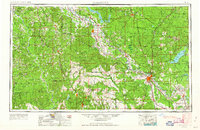 1953 Alexandria1963 Print · USGSCentral Louisiana during the early fifties is mapped here at the intersection of the piney woods and the Red River valley. Genealogists and historians can trace the rail-and-river network connecting towns like Alexandria, Natchitoches, and the grounds of Camp Beauregard.3 unique versions available
 - 1953 Map of Palestine, 1964 Print
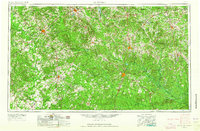 1953 Palestine1964 Print · USGSEast Texas was defined by its deep pine forests and burgeoning energy sector in the mid-1950s. Genealogists and historians can trace the rail-and-river economy through settlements like Tennessee Colony and Pollok or explore the early footprints of the Cayuga Oil Field and Davy Crockett National Forest.2 unique versions available
 - 1955 Map of Alexandria
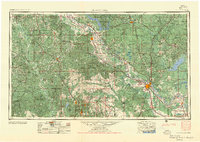 1955 Alexandria1955 Print · USGSCentral Louisiana in the mid-fifties is a landscape of river-port cities, sprawling timberlands, and massive military reservations. Genealogists and historians can trace the rail networks of the Texas & Pacific RR and locate sites like Camp Polk Military Reservation and Natchitoches.
 - 1956 Map of Logansport, 1957 Print
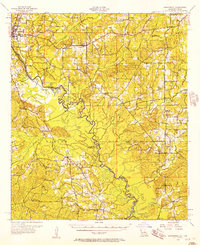 1956 Logansport1957 Print · USGSDe Soto Parish and the Texas borderlands come alive in this mid-century survey of the Sabine River valley. Genealogists can trace local landmarks like Pauls Store, Mt Olivet Ch, and the Third Ward Sch across a landscape of rails and river bends.4 unique versions available
 - 1956 Map of Patroon, 1957 Print
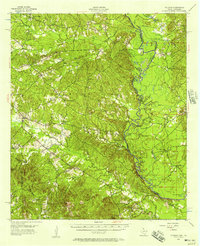 1956 Patroon1957 Print · USGSThe Texas-Louisiana borderlands along the Sabine River are captured here in the mid-1950s, showing a landscape of river bends and pine forests. Genealogists can trace family footprints through rural sites like Bulls Ankle, Ragtown, and Harvey Cem.4 unique versions available
 - 1957 Map of Palestine
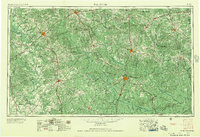 1957 Palestine1957 Print · USGSEast Texas in the mid-fifties reveals a landscape of deep pine forests and winding river valleys before the era of massive reservoir construction. Researchers can trace the legacy of the timber and rail industries through labels for the Missouri Pacific RR, Davy Crockett National Forest, and Nacogdoches.
 - 1958 Map of Center, 1959 Print
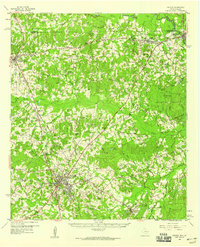 1958 Center1959 Print · USGSShelby County in the late fifties remains a landscape of timbered hills and rail-connected crossroads. Researchers can trace family roots through numerous rural sites like Newhope Ch, Union Cem, and the small community of Shelbyville near the Sabine River.3 unique versions available
 - 1958 Map of San Augustine, 1959 Print
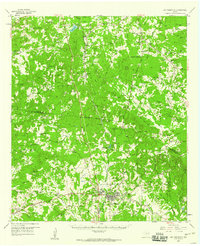 1958 San Augustine1959 Print · USGSSan Augustine County in the late fifties was a landscape of timber and tradition, where El Camino Real still traced its ancient path. Genealogists can locate dozens of rural landmarks, from Bland Lake to the Chumley Cem and Neuville Sch.2 unique versions available
 - 1958 Map of Martinsville, 1959 Print
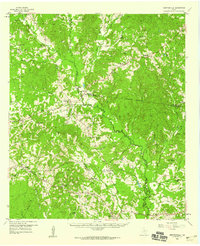 1958 Martinsville1959 Print · USGSNacogdoches County in the late 1950s is defined by the historic path of El Camino Real and the winding Attoyac Bayou. Researchers can trace old family sites at Sacred Heart Ch, Libby Cem, and the rural community of Martinsville.2 unique versions available
 - 1958 Map of Timpson, 1959 Print
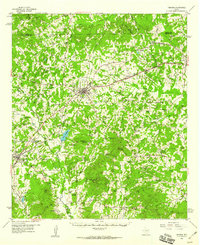 1958 Timpson1959 Print · USGSShelby and Nacogdoches counties appear here during the late fifties, defined by a landscape of small timber-and-oil settlements and diverging rail lines. Genealogists can locate family landmarks such as Todd Spring Ch, Huber Sch, and Lake Timpson.2 unique versions available
End of results
Showing maps 1-10 of 10
Top cities of Shelby County
- Center historical maps
- Timpson historical maps
- Tenaha historical maps
- Joaquin historical maps
- Huxley historical maps
Frequently asked questions
- What are the different types of historical maps available for Shelby County?
- What is the oldest map of Shelby County?
- Where can I purchase historical maps of Shelby County for my home or office?
- Where can I download high-res historical maps of Shelby County?
- Are there historical topographic maps available for Shelby County?
- Is there historical aerial imagery available for Shelby County?
- Where are historical maps of Shelby County sourced from?