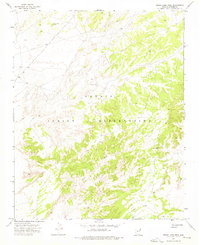
1972 Map of Boggy Lake Well
USGS Topo · Published 1976About this map
The Navajo Indian Reservation landscape is defined here by the seasonal drainage of Sabito Wash as it carves through the arid terrain of Apache County. This 1970s survey captures a sparse but vital network of water resources and infrastructure, centered on remote outposts like Boggy Lake Well and Phillip Joe Well. These named wells, along with scattered Corral sites, signify the essential water management required for livestock and settlement in the high desert. To the north, Turning Hill provides a distinct topographic landmark, while a Pipeline and several Jeep Trail routes snake across the mesas, indicating the encroaching industrial and transportation needs of the late twentieth century. This map serves as a clear record of the relationship between indigenous land use and modern utility development in the American Southwest.
Find a feature on this map
8 named features on this map. Tap any name to fly to it.
Don’t see what you’re looking for? This feature index may not catch every label — zoom into the map to look around manually.
Map Details
Editions of this 1972 Boggy Lake Well Map
This is the sole edition of this map. No revisions or reprints were ever made.
Other maps of this area
1886 · Fort Defiance
USGS Topo · 1:250,000
1892 · Fort Defiance
USGS Topo · 1:250,000
1954 · Gallup
USGS Topo · 1:250,000
1958 · Gallup
USGS Topo · 1:250,000
1959 · Gallup
USGS Topo · 1:250,000
1962 · Gallup
USGS Topo · 1:250,000
1967 · Gallup
USGS Topo · 1:250,000
1972 · Tanner Springs
USGS Topo · 1:24,000
1972 · Greasewood
USGS Topo · 1:24,000
1972 · Arrowhead Butte NE
USGS Topo · 1:24,000