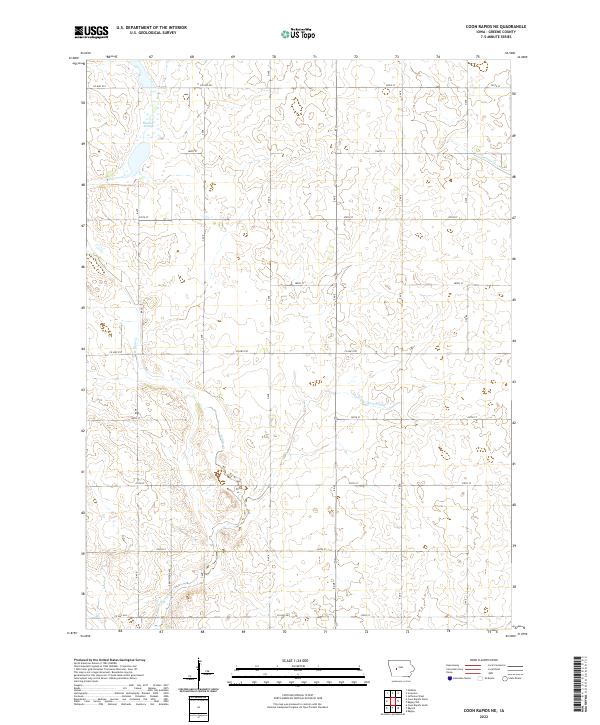
2022 Map of Coon Rapids NE
USGS Topo · Published 2022About this map
Dunbar Slough dominates the northwestern corner of this agricultural landscape in Greene County, reflecting the complex water management history of the Iowa prairie. The terrain is defined by a grid of rural roads such as 260th St and 300th St, which trace the section lines established by the Public Land Survey System. Intersecting this rigid human geometry are the meandering courses of Willow Cr and Greenbrier Cr. The engineering of the land for cultivation is most evident in features like Drainage Ditch Number 117, a critical component for draining the fertile lowlands. Spanning four townships, including t83n r32w and t82n r31w, the area remains a quintessential example of the modern Midwestern grain belt, where natural wetlands and technological water control exist side-by-side.
Find a feature on this map
19 named features on this map. Tap any name to fly to it.
Don’t see what you’re looking for? This feature index may not catch every label — zoom into the map to look around manually.
Map Details
Editions of this 2022 Coon Rapids NE Map
This is the sole edition of this map. No revisions or reprints were ever made.
Other maps of this area
1954 · Bagley
USGS Topo · 1:62,500
1954 · Omaha
USGS Topo · 1:250,000
1954 · Fort Dodge
USGS Topo · 1:250,000
1957 · Omaha
USGS Topo · 1:250,000
1957 · Fort Dodge
USGS Topo · 1:250,000
1958 · Omaha
USGS Topo · 1:250,000
1958 · Fort Dodge
USGS Topo · 1:250,000
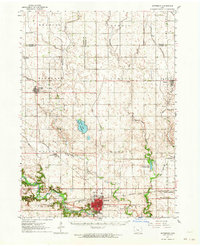
1962 · Jefferson
USGS Topo · 1:62,500
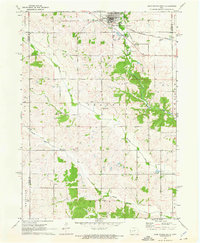
1971 · Coon Rapids South
USGS Topo · 1:24,000
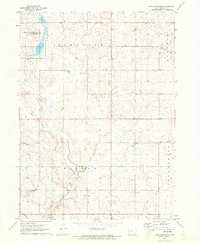
1971 · Coon Rapids NE
USGS Topo · 1:24,000
Featured Places
- Jackson Township, IA
- Scranton Township, IA
- Willow Township, IA
- Greenbrier Township, IA
- Greene County, IA