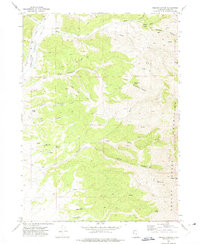
1971 Map of Ingham Canyon
USGS Topo · Published 1975About this map
The Grouse Mountains define this high-elevation landscape in northwestern Utah, centered on the prominent Ingham Peak. During the early 1970s, this area remained largely defined by its natural water sources and remote accessibility, marked by a network of Jeep Trails that connect family-named landmarks like Paskett Spring and Cook Spring. Small-scale resource extraction is evident near Ingham Canyon, where localized Mines are documented alongside seasonal water features such as the Flowing Well and North Bedke Spring. The map captures a moment when the regional economy was tied closely to these scattered springs and the drainages of Red Butte Creek and Pine Creek, providing essential data for those tracing the history of land use and surveying in Box Elder County.
Find a feature on this map
31 named features on this map. Tap any name to fly to it.
Don’t see what you’re looking for? This feature index may not catch every label — zoom into the map to look around manually.
Map Details
Editions of this 1971 Ingham Canyon Map
This is the sole edition of this map. No revisions or reprints were ever made.
Other maps of this area
1954 · Brigham City
USGS Topo · 1:250,000
1958 · Brigham City
USGS Topo · 1:250,000
1959 · Cotton Thomas Basin
USGS Topo · 1:62,500
1959 · Yost
USGS Topo · 1:62,500
1962 · Brigham City
USGS Topo · 1:250,000
1971 · Emigrant Pass
USGS Topo · 1:24,000
1971 · Toms Cabin Spring
USGS Topo · 1:24,000
1971 · Potters Creek
USGS Topo · 1:24,000
1971 · Grouse Creek
USGS Topo · 1:24,000
1971 · Rocky Pass Peak
USGS Topo · 1:24,000