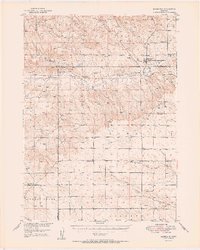
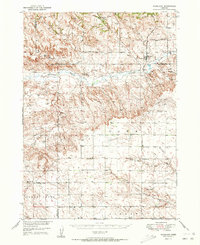
1951 Map of Marsland
USGS Topo · Published 1951About this map
The Niobrara River carves through the High Plains of western Nebraska in this mid-century survey, anchoring the village of Marsland. The settlement serves as a focal point along the Chicago Burlington and Quincy railroad, which parallels the river valley. To the north, the elevation rises toward the Pine Ridge, while the surrounding plateau is defined by a dense network of early rural infrastructure. This landscape is notably punctuated by numerous one-room schoolhouses, including School No 103, School No 61, and the specifically noted School No 76 (Abandoned), illustrating the shifting population density of the era. Genealogists will find the Marsland Cem and St. Marys Ch as significant markers of the local community. The drainage patterns of Snake Creek and Point of Rocks Creek further define the terrain, showing the vital relationship between water sources and early homesteading patterns across the county lines of Dawes, Sioux, and Box Butte.
Find a feature on this map
22 named features on this map. Tap any name to fly to it.
Don’t see what you’re looking for? This feature index may not catch every label — zoom into the map to look around manually.
Map Details
Editions of this 1951 Marsland Map
3 editions found
Other maps of this area
1899 · Whistle Creek
USGS Topo · 1:125,000
1946 · Nonpareil
USGS Topo · 1:24,000
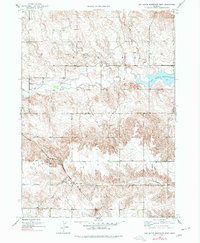
1946 · Box Butte Reservoir West
USGS Topo · 1:24,000
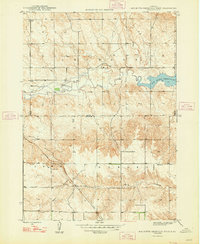
1948 · Box Butte Reservoir West
USGS Topo · 1:24,000
1948 · Hemingford 4 NW
USGS Topo · 1:24,000
1948 · Nonpareil
USGS Topo · 1:24,000
1951 · Marsland
USGS Topo · 1:62,500
1951 · Kilpatrick Lake
USGS Topo · 1:62,500
1955 · Alliance
USGS Topo · 1:250,000
1957 · Alliance
USGS Topo · 1:250,000