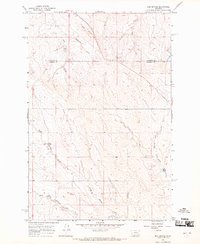
1965 Map of Red Buttes
USGS Topo · Published 1969About this map
Red Buttes dominates this landscape along the border of Rosebud and Garfield counties in the mid-1960s. This portion of Eastern Montana is characterized by a high-density drainage network of coulees and creeks that define the local topography. Water sources are critical in this arid environment, marked by named points like Potter Spring and Rock Spring. The map documents a landscape primarily managed for ranching or resource extraction, indicated by various Well sites and bench marks such as Rock Springs BM 3087. The intricate flow of North Sunday Creek and its tributaries, including West Fork North Sunday Creek, illustrates the complex erosion patterns typical of the region's sedimentary geology. Local history is reflected in the naming of features like Mackenzie Coulee and Rock Springs Creek, which likely denote early landholders or significant watering holes for livestock during the mid-20th century.
Find a feature on this map
14 named features on this map. Tap any name to fly to it.
Don’t see what you’re looking for? This feature index may not catch every label — zoom into the map to look around manually.
Map Details
Editions of this 1965 Red Buttes Map
This is the sole edition of this map. No revisions or reprints were ever made.
Other maps of this area
1954 · Forsyth
USGS Topo · 1:250,000
1957 · Forsyth
USGS Topo · 1:250,000
1958 · Forsyth
USGS Topo · 1:250,000
1965 · Rock Springs School
USGS Topo · 1:24,000
1965 · Little Chalk Butte
USGS Topo · 1:24,000
1965 · Clear Water Reservoir
USGS Topo · 1:24,000
1965 · Coleman Coulee
USGS Topo · 1:24,000
1965 · Hillside
USGS Topo · 1:24,000
1969 · Van Burton Creek
USGS Topo · 1:24,000
1969 · Alkali Creek
USGS Topo · 1:24,000