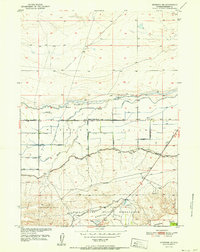
1952 Map of Riverton NE
USGS Topo · Published 1952About this map
Missouri Valley serves as a central hub of agricultural development in this 1952 study, defined by an intricate network of irrigation and water management. The landscape is carved by the Pilot Canal and the Riverton Valley Canal, which redirect water across the arid terrain to support the farms along Missouri Valley Road. This system of lateral ditches and siphons illustrates the mid-century engineering required to sustain life and industry in the Fremont County interior. The northern boundary of the Wind River Indian Reservation meets the valley floor, where the Missouri Valley Church and several quarries indicate a settled rural community. Natural drainage through Fivemile Creek and Sand Gulch contrasts with the straight lines of the man-made canals, while a Landing Field and multiple Gaging Sta markers suggest the era's reliance on both aviation and precise hydrological monitoring.
Find a feature on this map
13 named features on this map. Tap any name to fly to it.
Don’t see what you’re looking for? This feature index may not catch every label — zoom into the map to look around manually.
Map Details
Editions of this 1952 Riverton NE Map
This is the sole edition of this map. No revisions or reprints were ever made.
Other maps of this area
1950 · Riverton East
USGS Topo · 1:24,000
1950 · Mexican Pass SW
USGS Topo · 1:24,000
1950 · Bonneville SW
USGS Topo · 1:24,000
1951 · Mexican Pass SE
USGS Topo · 1:24,000
1951 · Indian Butte
USGS Topo · 1:24,000
1951 · Hidden Valley
USGS Topo · 1:24,000
1951 · Riverton West
USGS Topo · 1:24,000
1952 · Lost Wells Butte
USGS Topo · 1:24,000
1955 · Thermopolis
USGS Topo · 1:250,000
1957 · Hidden Valley
USGS Topo · 1:24,000