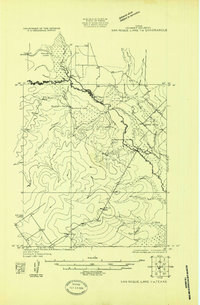
1925 Map of San Roque Lake 1-a
USGS Topo · Published 1925About this map
The Nueces River winds through this South Texas landscape, defining a region of riparian bottomlands and ranching outposts in the mid-1920s. Established by the State of Texas Board of Water Engineers, this survey details a period when water access was the primary driver of settlement in the brush country. The map highlights the early development of Valley Wells and a network of remote family operations, including the Buckhorn Ranch and Rasmussen Ranch. Transport in the area is anchored by the Big Wells Road, which connects these isolated outposts across a terrain marked by ephemeral drainages like Sauce Creek and Appurceon Creek. Notable water features such as Encina Lake and Buckhorn Lake serve as critical landmarks for genealogists and local historians tracing the early twentieth-century land use of Dimmit County.
Find a feature on this map
13 named features on this map. Tap any name to fly to it.
Don’t see what you’re looking for? This feature index may not catch every label — zoom into the map to look around manually.
Map Details
Editions of this 1925 San Roque Lake 1-a Map
This is the sole edition of this map. No revisions or reprints were ever made.
Other maps of this area
1927 · Bart
USGS Topo · 1:62,500
1929 · Cotulla
USGS Topo · 1:125,000
1932 · Valley Wells
USGS Topo · 1:62,500
1939 · Big Wells
USGS Topo · 1:62,500
1940 · Catarina
USGS Topo · 1:62,500
1940 · Artesia Wells
USGS Topo · 1:62,500
1953 · Crystal City
USGS Topo · 1:250,000
1955 · Crystal City
USGS Topo · 1:250,000
1956 · Woodward
USGS Topo · 1:62,500
1961 · Crystal City
USGS Topo · 1:250,000