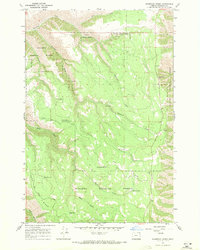
1967 Map of Shamrock Creek
USGS Topo · Published 1971About this map
Wallowa National Forest dominates this 1960s topographic landscape, defined by a complex network of canyons and high ridges in Wallowa County. The drainage patterns of Shamrock Creek and Courtney Creek carve through the terrain, separated by prominent landforms like Day Ridge and Kuhn Ridge. While the area is largely characterized by its natural features, specific water resources such as Foundation Spring, Burnt Spring, and the Wade Pond catchment indicate the importance of water management for livestock or forest service use in this environment. A lone Gravel Pit and the Joseph Canyon Viewpoint suggest limited human infrastructure, primarily focused on forest transit and resource extraction. Significant elevation changes are mapped with precision, showing the steep descent toward Mud Creek in the north and the isolated Reed Reservoir tucked into a southern canyon fold.
Find a feature on this map
15 named features on this map. Tap any name to fly to it.
Don’t see what you’re looking for? This feature index may not catch every label — zoom into the map to look around manually.
Map Details
Editions of this 1967 Shamrock Creek Map
This is the sole edition of this map. No revisions or reprints were ever made.
Other maps of this area
1955 · Grangeville
USGS Topo · 1:250,000
1957 · Sled Springs
USGS Topo · 1:62,500
1957 · Elk Mountain
USGS Topo · 1:62,500
1959 · Grangeville
USGS Topo · 1:250,000
1967 · Wood Butte
USGS Topo · 1:24,000
1967 · Troy
USGS Topo · 1:24,000
1967 · Table Mountain
USGS Topo · 1:24,000
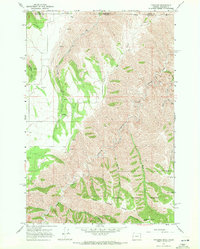
1967 · Paradise
USGS Topo · 1:24,000
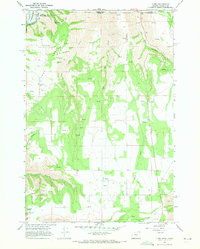
1967 · Flora
USGS Topo · 1:24,000
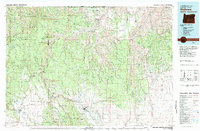
1982 · Wallowa
USGS Topo · 1:100,000