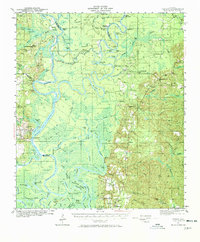
1943 Map of Tensaw
USGS Topo · Published 1969About this map
The confluence of the Alabama River and the Tombigbee River dominates this landscape, where the waters merge into the Mobile River amidst a complex network of bayous, sloughs, and islands. In the early 1940s, this area of Baldwin and Mobile Counties remained a land of river landings and plantation tracts, including the Davis Plantation and Singleton Plantation. The geography is defined by water movement, seen in the Cutoff and Deep Slough, which carved out massive landmasses like Bilbo Island and Robinson Island. Settlements such as Stockton and Latham serve as interior anchors, while the river banks are dotted with historic transit points like Old Ft Stoddard Mt Vernon Ldg. This survey captures the transition from river-dependent commerce to inland farming, evidenced by the numerous country schools like Majors Creek Sch and the Gopher Hill Fire Tower standing watch over the pine-heavy terrain.
Find a feature on this map
136 named features on this map. Tap any name to fly to it.
Don’t see what you’re looking for? This feature index may not catch every label — zoom into the map to look around manually.
Map Details
Editions of this 1943 Tensaw Map
2 editions found
Other maps of this area
1941 · Bay Minette
USGS Topo · 1:62,500
1941 · Creola
USGS Topo · 1:62,500
1942 · Perdido
USGS Topo · 1:62,500
1942 · Dyas
USGS Topo · 1:62,500
1943 · Creola
USGS Topo · 1:62,500
1943 · Bay Minette
USGS Topo · 1:62,500
1943 · Choctaw Bluff
USGS Topo · 1:62,500
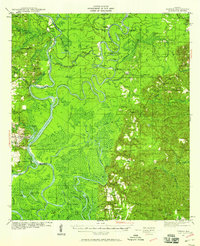
1943 · Tensaw
USGS Topo · 1:62,500
1943 · Citronelle
USGS Topo · 1:62,500
1943 · McIntosh
USGS Topo · 1:62,500