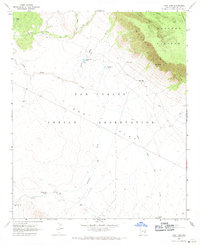
1967 Map of Tule Tubs
USGS Topo · Published 1971About this map
The San Carlos Indian Reservation landscape is defined by the dramatic ascent of the Nantac Rim, where the desert floor gives way to the elevated Nantac Plateau. This 1967 survey captures a remote ranching and water-management network essential for livestock in the arid Southwest. A series of specialized water features, including Soldier Hole Tank, Arsenic Tank, and Pasture 5 Charco, are distributed across the broad expanse of Ash Flat. These improvements, along with Sunrise Well and Hooker Gap Well, trace the human effort to sustain cattle in a territory where natural springs like Tule Springs and the eponymous Tule Tubs are rare and vital resources. Navigation across this terrain in the late 1960s relied on a sparse network of a Jeep Trail and the Natanes Mts Trail, reflecting the area's isolation.
Find a feature on this map
24 named features on this map. Tap any name to fly to it.
Don’t see what you’re looking for? This feature index may not catch every label — zoom into the map to look around manually.
Map Details
Editions of this 1967 Tule Tubs Map
This is the sole edition of this map. No revisions or reprints were ever made.
Other maps of this area
1954 · Clifton
USGS Topo · 1:250,000
1954 · Mesa
USGS Topo · 1:250,000
1957 · Mesa
USGS Topo · 1:250,000
1957 · Clifton
USGS Topo · 1:250,000
1958 · Clifton
USGS Topo · 1:250,000
1958 · Mesa
USGS Topo · 1:250,000
1960 · Mesa
USGS Topo · 1:250,000
1960 · Bylas
USGS Topo · 1:62,500
1960 · Fort Thomas
USGS Topo · 1:62,500
1962 · Clifton
USGS Topo · 1:250,000