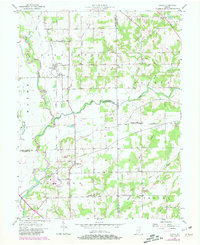
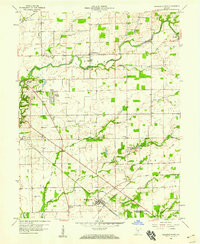
1957 Map of Azalia
USGS Topo · Published 1981About this map
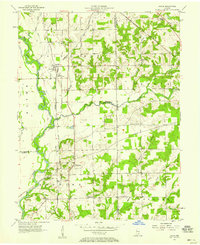
Azalia and Reddington serve as the primary hubs in this mid-century portrait of south-central Indiana. The landscape is defined by the winding East Fork White River and its numerous tributaries, including Sand Creek and Mutton Creek. A notable historical marker on this map is the Indian Treaty Boundary, which cuts diagonally across the southern half of the quadrangle, reflecting early 19th-century land divisions. Religious and community life are well-documented through rural landmarks like the Friends Meetinghouse, Wilson Chapel, and several local schools like the Township Sch. While much of the terrain is dedicated to agriculture, localized infrastructure is visible at the Pumping Station and along the various pipelines crossing the county lines of Bartholomew and Jennings. Genealogists may find value in the specific locations of the Sand Creek Cem and Glasson Cem.
Find a feature on this map
30 named features on this map. Tap any name to fly to it.
Don’t see what you’re looking for? This feature index may not catch every label — zoom into the map to look around manually.
Map Details
Editions of this 1957 Azalia Map
4 editions found
Other maps of this area
1942 · Columbus
USGS Topo · 1:125,000
1953 · Cincinnati
USGS Topo · 1:250,000
1956 · Louisville
USGS Topo · 1:250,000
1957 · Cincinnati
USGS Topo · 1:250,000
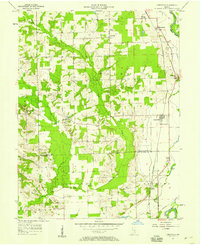
1957 · Jonesville
USGS Topo · 1:24,000
1957 · Azalia
USGS Topo · 1:24,000
1957 · North Vernon
USGS Topo · 1:24,000
1958 · Columbus
USGS Topo · 1:24,000
1958 · Grammer
USGS Topo · 1:24,000
1958 · Elizabethtown
USGS Topo · 1:24,000