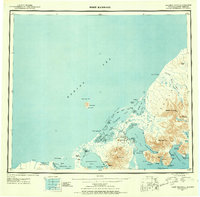
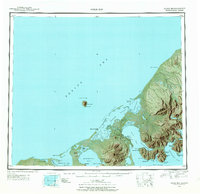
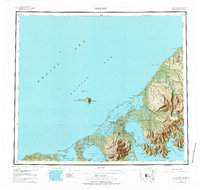
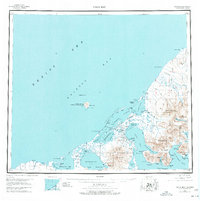
1943 Map of Fort Randall
USGS Topo · Published 1954About this map
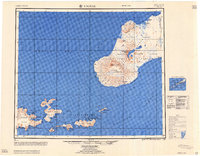
Fort Randall stands at the strategic entrance to the Bering Sea on the Alaska Peninsula during the height of World War II activity. This reconnaissance-level survey, based on aerial photography from 1942 and 1943, documents the critical military infrastructure established in the region, most notably Thornbrough Air Force Base and its proximity to Cold Bay. The map captures a transitional moment for the local economy and indigenous settlements, showing the established village of Belkofski and the industry at King Cove alongside a Cannery (Abandoned) in Morzhovoi Bay. The landscape is dominated by volcanic features like Frosty Peak and the striking Aghileen Pinnacles, illustrating the maritime hazards of the Bering Sea and Deer Passage during an era when these remote outposts were central to Pacific theater logistics.
Find a feature on this map
65 named features on this map. Tap any name to fly to it.
Don’t see what you’re looking for? This feature index may not catch every label — zoom into the map to look around manually.
Map Details
Editions of this 1943 Fort Randall Map
7 editions found
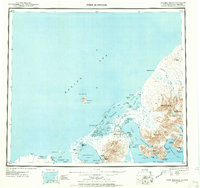
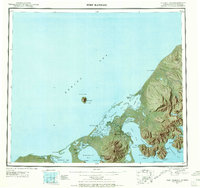
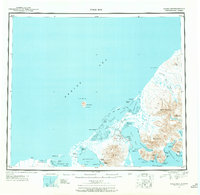
Other maps of this area
1944 · Cold Bay Sheet No. 20 of 25
USGS Topo · 1:25,000
1944 · Cold Bay Sheet No. 1 of 25
USGS Topo · 1:25,000
1944 · Cold Bay Sheet No. 2 of 25
USGS Topo · 1:25,000
1949 · False Pass
USGS Topo · 1:250,000
1949 · Fort Randall
USGS Topo · 1:250,000
1950 · False Pass
USGS Topo · 1:250,000
1950 · Fort Randall
USGS Topo · 1:250,000
1951 · Unimak
USGS Topo · 1:250,000
1953 · Port Moller
USGS Topo · 1:250,000
1958 · Unimak
USGS Topo · 1:250,000