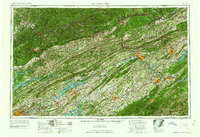
1963 Map of Johnson City
USGS Topo · Published 1963About this map
Johnson City and the Tri-Cities region emerge as a complex industrial and transport hub in this early 1960s study of the Southern Appalachians. The landscape is defined by the repetitive northeast-to-southwest ridges of Clinch Mountain and Copper Ridge, creating natural corridors for major infrastructure. The rail networks of the Southern Ry, Louisville & Nashville RR, and the Clinchfield RR illustrate the region's historical reliance on coal transport and manufacturing. In the valleys, the massive impoundments of the Tennessee Valley Authority, including Norris Lake, Cherokee Lake, and Douglas Lake, demonstrate the mid-century transformation of the river systems. To the east and west, the high elevations of the Cherokee National Forest and Jefferson National Forest frame the settled valleys, while the Kentucky coalfields around Harlan and Middlesboro represent the heavy extraction economy active during this era.
Find a feature on this map
76 named features on this map. Tap any name to fly to it.
Don’t see what you’re looking for? This feature index may not catch every label — zoom into the map to look around manually.
Map Details
Editions of this 1963 Johnson City Map
This is the sole edition of this map. No revisions or reprints were ever made.
Other maps of this area
1883 · Morristown
USGS Topo · 1:125,000
1886 · Knoxville
USGS Topo · 1:125,000
1886 · Grundy
USGS Topo · 1:125,000
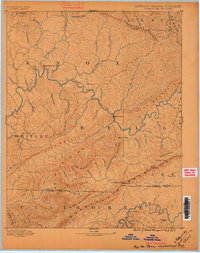
1886 · Cumberland Gap
USGS Topo · 1:125,000
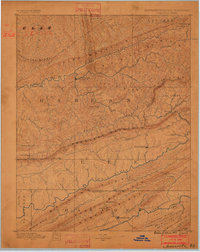
1887 · Jonesville
USGS Topo · 1:125,000
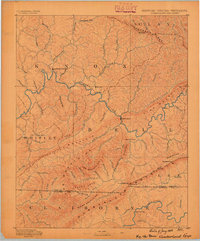
1888 · Cumberland Gap
USGS Topo · 1:125,000
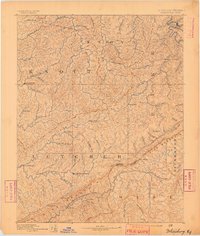
1890 · Whitesburg
USGS Topo · 1:125,000
1890 · Grundy
USGS Topo · 1:125,000
1890 · Williamsburg
USGS Topo · 1:125,000
1891 · Tazewell
USGS Topo · 1:125,000