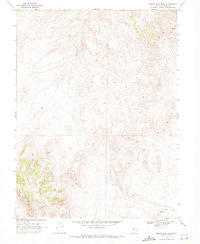
1969 Map of Mount Airy Mesa
USGS Topo · Published 1971About this map
Mount Airy Mesa dominates the southwestern quadrant of this high-desert landscape in central Nevada. Surveyed in the late 1960s, the terrain is defined by dramatic elevation changes and seasonal drainage patterns, most notably Antelope Creek, which winds through the central valley. Human activity is sparse and primarily industrial or ranching-oriented, evidenced by the presence of a lone Corral in the south and the Maloy Mine situated in the northeastern highlands. A network of primitive transport, including a designated Jeep Trail, provides the only access through these high-altitude ranges. The map provides a clear look at the township and range system at the junction of T. 20 N. and T. 19 N., reflecting the systematic land division used by the Department of the Interior to manage this part of the public domain.
Find a feature on this map
7 named features on this map. Tap any name to fly to it.
Don’t see what you’re looking for? This feature index may not catch every label — zoom into the map to look around manually.
Map Details
Editions of this 1969 Mount Airy Mesa Map
This is the sole edition of this map. No revisions or reprints were ever made.
Other maps of this area
1955 · Millett
USGS Topo · 1:250,000
1956 · Austin
USGS Topo · 1:62,500
1959 · Millett
USGS Topo · 1:250,000
1969 · Mount Airy
USGS Topo · 1:24,000
1969 · Vigus Butte
USGS Topo · 1:24,000
1969 · Vigus Butte NW
USGS Topo · 1:24,000
1969 · Mount Airy NW
USGS Topo · 1:24,000
1969 · Mount Airy NE
USGS Topo · 1:24,000
1969 · Gandolfo Canyon
USGS Topo · 1:24,000
1969 · Emigrant Peak
USGS Topo · 1:24,000