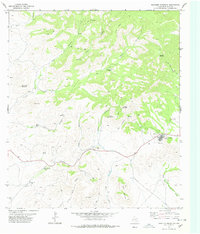
1978 Map of Paradise Mountain
USGS Topo · Published 1978About this map
Bloys Camp Meeting and its associated Grave sit at the intersection of high desert terrain and seasonal watercourses in the late 1970s. This survey of Jeff Davis County illustrates a landscape of isolation and strategic water management, where named features often revolve around reliable sources like Barrel Spring and the Blackeye Tank. The topography is defined by significant elevations, including Paradise Mountain and White Mountain, which loom over a network of canyons such as Wood Canyon and Merrill Canyon. Evidence of early 20th-century religious traditions is preserved at the camp meeting grounds, while the presence of a Landing Strip and various Prospects suggests the continued modern utility of this remote area. The drainage system of the North Fork Alamito Creek and South Fork Alamito Creek provides a clear view of the region's natural watershed in the Davis Mountains area.
Find a feature on this map
35 named features on this map. Tap any name to fly to it.
Don’t see what you’re looking for? This feature index may not catch every label — zoom into the map to look around manually.
Map Details
Editions of this 1978 Paradise Mountain Map
This is the sole edition of this map. No revisions or reprints were ever made.
Other maps of this area
1894 · Valentine
USGS Topo · 1:125,000
1895 · Marfa
USGS Topo · 1:125,000
1897 · Valentine
USGS Topo · 1:125,000
1943 · Valentine
USGS Topo · 1:125,000
1959 · Marfa
USGS Topo · 1:250,000
1965 · Marfa
USGS Topo · 1:250,000
1978 · Blue Mountain
USGS Topo · 1:24,000
1978 · El Muerto Peak
USGS Topo · 1:24,000
1978 · Mount Livermore
USGS Topo · 1:24,000
1978 · San Antonio Pass
USGS Topo · 1:24,000