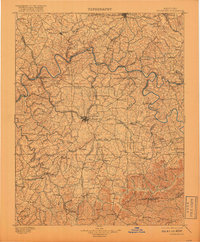
1897 Map of Richmond
USGS Topo · Published 1918About this map
The Kentucky River carves a winding, serpentine path through the heart of the Bluegrass region, serving as a vital corridor for commerce and travel in the late 19th century. This landscape is defined by its reliance on water crossings and rail connectivity, with numerous river crossings such as Combs Ferry, Jackson Ferry, and State Creek Ferry facilitating movement before widespread bridge construction. Major rail arteries, including the Louisville and Nashville R. R. and the Chesapeake and Ohio R. R., intersect at established hubs like Winchester and Richmond. Smaller communities such as Boonesboro and Valley View anchor the riverbanks, while the presence of a Stone Quarry and features like White Hall indicate the industrial and social footprint of the era. The terrain transitions from the river valley to prominent heights like Combs Mtn. and Joe Lick Knob.
Find a feature on this map
163 named features on this map. Tap any name to fly to it.
Don’t see what you’re looking for? This feature index may not catch every label — zoom into the map to look around manually.
Map Details
Editions of this 1897 Richmond Map
5 editions found
Other maps of this area
1891 · Manchester
USGS Topo · 1:125,000
1892 · Richmond
USGS Topo · 1:125,000
1892 · Beattyville
USGS Topo · 1:125,000
1893 · London
USGS Topo · 1:125,000
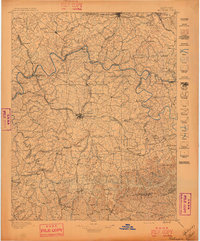
1897 · Richmond
USGS Topo · 1:125,000
1897 · London
USGS Topo · 1:125,000
1905 · Harrodsburg
USGS Topo · 1:125,000
1906 · Georgetown
USGS Topo · 1:62,500
1908 · Georgetown
USGS Topo · 1:62,500
1927 · Lexington
USGS Topo · 1:48,000