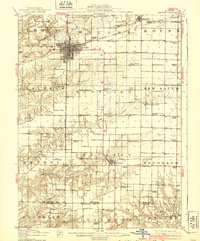
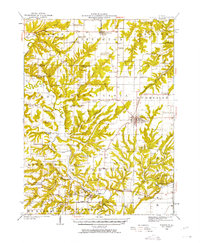
1914 Map of Macomb
USGS Topo · Published 1939About this map
Macomb stands as the central hub of this early twentieth-century survey, its grid concentrated at the intersection of the Chicago Burlington and Quincy railroad and the Waubonsie Trail. This map captures a landscape defined by an exceptionally dense network of rural schoolhouses, with nearly every section of the surrounding townships supporting sites like Gooseneck School, Litchfield School, and Ebenezer School. To the south, the terrain becomes more dissected as the Lamoine River and its tributaries, including Troublesome Creek and Grindstone Creek, cut through the prairie. Industrial activity is noted north of the city at a Clay Mine, while small outlying communities like Bardolph and Industry anchor the surrounding agricultural townships. The distribution of these named landmarks provides a clear picture of the township-and-range settlement pattern before the consolidation of rural infrastructure.
Find a feature on this map
81 named features on this map. Tap any name to fly to it.
Don’t see what you’re looking for? This feature index may not catch every label — zoom into the map to look around manually.
Map Details
Editions of this 1914 Macomb Map
4 editions found
Other maps of this area
1912 · Macomb
USGS Topo · 1:62,500
1913 · Colchester
USGS Topo · 1:62,500
1914 · Macomb
USGS Topo · 1:62,500
1915 · Avon
USGS Topo · 1:62,500
1916 · Good Hope
USGS Topo · 1:62,500
1918 · Vermont
USGS Topo · 1:62,500
1918 · La Harpe
USGS Topo · 1:62,500
1918 · Good Hope
USGS Topo · 1:62,500
1921 · Vermont
USGS Topo · 1:62,500
1923 · Rushville
USGS Topo · 1:62,500