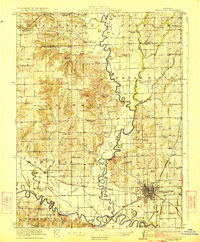
1923 Map of Chillicothe
USGS Topo · Published 1923About this map
Chillicothe serves as the dominant rail and commerce hub in this 1920s survey, situated at the junction of several major lines including the Wabash and the Chicago Burlington and Quincy. The landscape is defined by the winding course of the Thompson River as it joins the Grand River south of town, creating a complex floodplain punctuated by numerous rural school districts. These local schools, such as American Bottoms School, Happy Hollow School, and Prairie Valley School, reflect a decentralized educational system serving the surrounding farmsteads of Rich Hill and Cream Ridge. In the northwestern portion of the map, the small settlement of Hickory P O and the Shelburn Church highlight the persistent importance of early postal and religious centers. The rail network, featuring the Chicago Milwaukee and St Paul and the Pacific lines, provides a clear view of how transit dictated the growth of towns like Sampsell and Mooresville during this era.
Find a feature on this map
73 named features on this map. Tap any name to fly to it.
Don’t see what you’re looking for? This feature index may not catch every label — zoom into the map to look around manually.
Map Details
Editions of this 1923 Chillicothe Map
2 editions found
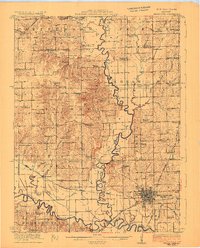
Other maps of this area
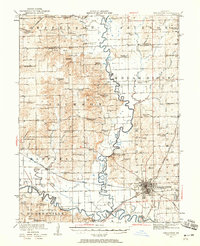
1921 · Chillicothe
USGS Topo · 1:62,500
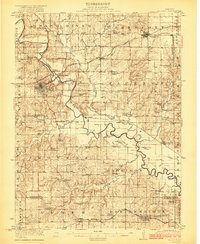
1922 · Gallatin
USGS Topo · 1:62,500
1924 · Dawn
USGS Topo · 1:62,500
1924 · Braymer
USGS Topo · 1:62,500
1924 · Chula
USGS Topo · 1:62,500
1924 · Hale
USGS Topo · 1:62,500
1925 · Gilman
USGS Topo · 1:62,500
1946 · Gilman
USGS Topo · 1:48,000
1946 · Galt
USGS Topo · 1:62,500
1947 · Chula
USGS Topo · 1:62,500