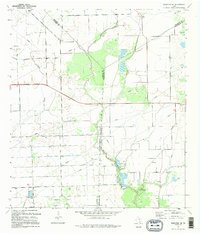
1995 Map of Francitas NE
USGS Topo · Published 1995About this map
Oil and gas infrastructure dominates this coastal Texas landscape, where the Mauritz Oil Field and Little Kentucky Oil Field intersect a complex network of pipelines. Tracing the convergence of Jackson, Matagorda, and Wharton counties, the map reveals a region defined by extraction and drainage. Waterways like East Carancahua Creek and Moccasin Creek meander through a grid of siphons, flumes, and levees, illustrating the intensive water management required for the surrounding fields. An interesting historical note is found in the center, where an indefinite boundary marks long-standing surveying ambiguities between Jackson and Matagorda counties. Further south, the North Francitas Oil Field includes a landing strip, signaling the specialized transportation needs of the mid-century petroleum industry.
Find a feature on this map
12 named features on this map. Tap any name to fly to it.
Don’t see what you’re looking for? This feature index may not catch every label — zoom into the map to look around manually.
Map Details
Editions of this 1995 Francitas NE Map
This is the sole edition of this map. No revisions or reprints were ever made.
Other maps of this area
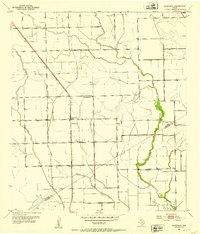
1951 · Danevang
USGS Topo · 1:24,000
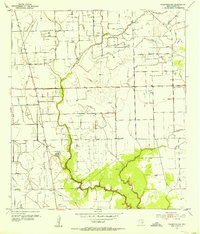
1952 · Francitas NW
USGS Topo · 1:24,000
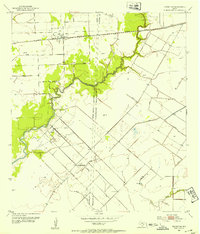
1952 · Francitas
USGS Topo · 1:24,000
1952 · Blessing
USGS Topo · 1:24,000
1952 · Francitas NE
USGS Topo · 1:24,000
1952 · Midfield
USGS Topo · 1:24,000
1952 · La Ward
USGS Topo · 1:24,000
1953 · Beeville
USGS Topo · 1:250,000
1953 · Seguin
USGS Topo · 1:250,000
1956 · Beeville
USGS Topo · 1:250,000