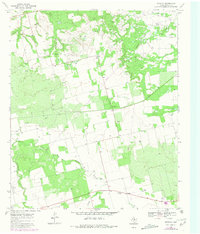
1969 Map of Royston
USGS Topo · Published 1981About this map
The community of Royston serves as the focal point for this section of West Texas, appearing as a modest junction during a period of significant regional energy development. Surveyed in the late 1960s with updates reaching into the early 1980s, the landscape is defined by the heavy presence of oil fields, where numerous wells and pipelines crisscross the terrain. This industrial infrastructure is superimposed over an older agricultural and ranching grid, indicated by the fine red dashed lines that delineate selected fence lines throughout the quadrangle. The intersection of these two economies—traditional ranching and modern petroleum extraction—characterizes the area's development during this era. Rural life remains anchored by scattered roadside features and local landmarks that provide essential orientation for researchers tracing the mid-century evolution of Fisher County.
Find a feature on this map
1 named feature on this map. Tap any name to fly to it.
Don’t see what you’re looking for? This feature index may not catch every label — zoom into the map to look around manually.
Map Details
Editions of this 1969 Royston Map
2 editions found
Other maps of this area
1893 · Roby
USGS Topo · 1:125,000
1926 · Roby 2-b
USGS Topo · 1:48,000
1931 · Rotan
USGS Topo · 1:62,500
1954 · Big Spring
USGS Topo · 1:250,000
1957 · Noodle
USGS Topo · 1:62,500
1958 · Big Spring
USGS Topo · 1:250,000
1965 · Hamlin NW
USGS Topo · 1:24,000
1965 · McCaulley
USGS Topo · 1:24,000
1969 · White Canyon
USGS Topo · 1:24,000
1969 · Poke Mountain
USGS Topo · 1:24,000