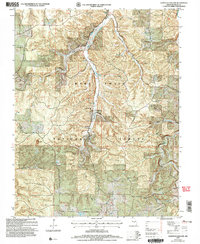
2004 Map of Kaintuck Hollow
USGS Topo · Published 2006About this map
The Mark Twain National Forest dominates this Missouri landscape, where the deeply carved terrain of Kaintuck Hollow and Hardester Hollow reveals a history of rural Missouri education and faith. The map serves as a primary record for genealogists, preserving the locations of numerous vanished institutions including the Western Star Sch (Site) and Colon Sch (Site). While the settlements themselves have largely receded into the forest, their spiritual and civic centers remain visible through labels for the Mill Creek Ch and several burial grounds like Upper Mill Creek Cem. The karst topography is evident in features such as the Natural Bridge and King Sink, which highlight the unique geology of the Ozark Plateau. Water sources such as Wilkins Spring and Elm Spring flow into the larger drainage of Mill Creek, defining the traditional movement patterns and homestead locations of the region.
Find a feature on this map
37 named features on this map. Tap any name to fly to it.
Don’t see what you’re looking for? This feature index may not catch every label — zoom into the map to look around manually.
Map Details
Editions of this 2004 Kaintuck Hollow Map
This is the sole edition of this map. No revisions or reprints were ever made.
Other maps of this area
1912 · Rolla
USGS Topo · 1:62,500
1936 · Waynesville
USGS Topo · 1:48,000
1937 · Edgar Springs
USGS Topo · 1:48,000
1941 · Big Piney
USGS Topo · 1:62,500
1942 · Waynesville
USGS Topo · 1:62,500
1943 · Big Piney
USGS Topo · 1:62,500
1944 · Waynesville
USGS Topo · 1:62,500
1945 · Edgar Springs
USGS Topo · 1:62,500
1949 · Rolla
USGS Topo · 1:250,000
1950 · Newburg
USGS Topo · 1:24,000