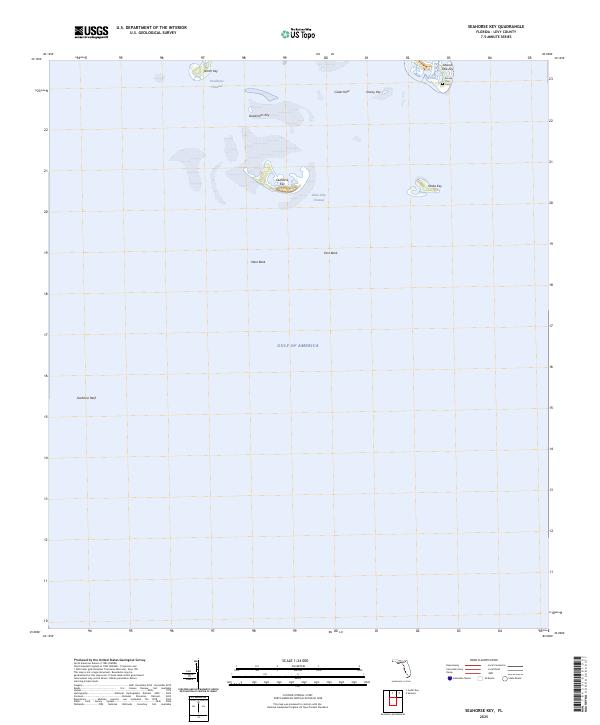
2025 Map of Seahorse Key
USGS Topo · Published 2025About this map
Atsena Otie Key and the surrounding island cluster anchor this coastal survey of the Cedar Keys archipelago. The map documents a landscape defined by tidal shifts and maritime passage, centered on the Main Ship Channel and the protective sweep of Seahorse Reef. For historians and genealogists, the presence of the Atsena Otie Cem on its namesake island provides a critical point of reference for the region's early settlement history. The archipelago extends through a series of significant landforms including North Key, Deadmans Key, and Snake Key, separated by navigable waters like Deadmans Channel. This contemporary survey by the U.S. Geological Survey captures the intricate relationship between the low-lying keys and the Gulf of America, tracing the shoals of the West Bank and East Bank that have dictated navigation in these waters for generations.
Find a feature on this map
14 named features on this map. Tap any name to fly to it.
Don’t see what you’re looking for? This feature index may not catch every label — zoom into the map to look around manually.
Map Details
Editions of this 2025 Seahorse Key Map
This is the sole edition of this map. No revisions or reprints were ever made.
Other maps of this area
1954 · Gainesville
USGS Topo · 1:250,000
1955 · Seahorse Key
USGS Topo · 1:24,000
1955 · Cedar Key
USGS Topo · 1:24,000
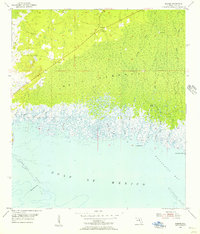
1955 · Sumner
USGS Topo · 1:24,000
1955 · Plant City
USGS Topo · 1:250,000
1958 · Plant City
USGS Topo · 1:250,000
1958 · Gainesville
USGS Topo · 1:250,000
1959 · Plant City
USGS Topo · 1:250,000
1959 · Gainesville
USGS Topo · 1:250,000
1964 · Plant City
USGS Topo · 1:250,000