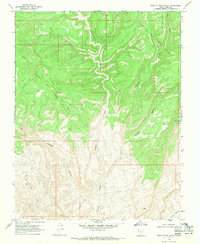
1968 Map of East of The Navajo
USGS Topo · Published 1971About this map
Fiftymile Mountain dominates the northeastern landscape of this Kane County terrain, where high plateaus give way to a complex system of drainage basins. This 1968 survey reveals a land defined by its deep vertical relief, notably at West End Point and Mudholes Point. The western portion is marked by the East of the Navajo region and the arid Burning Hills, characterized by scarce water sources and an absence of permanent settlements. Transportation across this demanding environment is limited to primitive Jeep Trails that snake through the canyon floors and across the uplands. Seasonal drainage is captured in a series of named arteries including Rogers Canyon, Monday Canyon, and Sunday Canyon, which eventually converge toward Croton Canyon in the south. The map illustrates a remote Utah wilderness prior to significant modern development, with only small pockets of low-lying relief like Little Valley breaking the high-desert topography.
Find a feature on this map
15 named features on this map. Tap any name to fly to it.
Don’t see what you’re looking for? This feature index may not catch every label — zoom into the map to look around manually.
Map Details
Editions of this 1968 East of The Navajo Map
2 editions found
Other maps of this area
1886 · Escalante
USGS Topo · 1:250,000
1922 · Warm Creek
USGS Topo · 1:63,360
1922 · Rees Canyon
USGS Topo · 1:63,360
1953 · Cummings Mesa
USGS Topo · 1:62,500
1953 · Gunsight Butte
USGS Topo · 1:62,500
1956 · Escalante
USGS Topo · 1:250,000
1960 · Escalante
USGS Topo · 1:250,000
1968 · Collet Top
USGS Topo · 1:24,000
1968 · Big Hollow Wash
USGS Topo · 1:24,000
1968 · Needle Eye Point
USGS Topo · 1:24,000