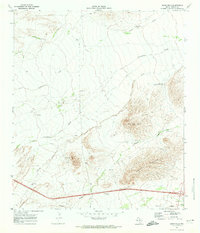
1970 Map of Meier Hills
USGS Topo · Published 1974About this map
Meier Hills and the New Well Hills dominate this West Texas landscape, rising above a network of ephemeral watercourses in Reeves County. The terrain is defined by dry drainage systems such as Fivemile Draw, Prizer Draw, and Hackberry Creek, which channel seasonal runoff toward the desert floor. Water management is a primary focus of this 1970 field check, evidenced by a prominent north-south Aqueduct and numerous isolated water stations. Scattered infrastructure for ranching and resource extraction includes the Fiorenzo Windmill, Bravo Windmill, and several Gravel Pits. Localized features like Cotton Springs and the North New Well Windmill mark rare points of reliable water in a region where travel often relied on a system of Jeep Trails and minor roads. Small markers like the Drill Hole locations suggest ongoing mineral exploration or geological surveying during this era.
Find a feature on this map
22 named features on this map. Tap any name to fly to it.
Don’t see what you’re looking for? This feature index may not catch every label — zoom into the map to look around manually.
Map Details
Editions of this 1970 Meier Hills Map
This is the sole edition of this map. No revisions or reprints were ever made.
Other maps of this area
1894 · Fort Davis
USGS Topo · 1:125,000
1897 · Fort Davis
USGS Topo · 1:125,000
1921 · Toyah
USGS Topo · 1:125,000
1954 · Pecos
USGS Topo · 1:250,000
1954 · Fort Stockton
USGS Topo · 1:250,000
1955 · Saragosa
USGS Topo · 1:62,500
1957 · Pecos
USGS Topo · 1:250,000
1958 · Fort Stockton
USGS Topo · 1:250,000
1970 · Florenzo Hill
USGS Topo · 1:24,000
1970 · Gozar
USGS Topo · 1:24,000