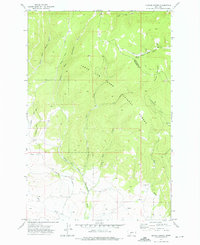
1972 Map of Hoover Spring
USGS Topo · Published 1976About this map
The Lewis and Clark National Forest encompasses the high country where the headwaters of several major Montana river systems emerge. This 1972 survey documents a hydrologically significant divide where the North Fork Smith River and the South Fork Judith River begin their descent. The landscape is defined by its drainage patterns, notably the Musselshell River and its North Fork Musselshell River, which carve through the terrain south of Hoover Mountain. Human activity is primarily represented by a network of historic tracks and paths, such as the Jamison Fork Trail and Jamison Trail, which likely trace older routes through the timber and meadows. The presence of Hoover Spring and various other seasonal springs indicates the importance of reliable water sources for both wildlife and the livestock that once utilized these forest allotments.
Find a feature on this map
22 named features on this map. Tap any name to fly to it.
Don’t see what you’re looking for? This feature index may not catch every label — zoom into the map to look around manually.
Map Details
Editions of this 1972 Hoover Spring Map
This is the sole edition of this map. No revisions or reprints were ever made.
Other maps of this area
1886 · Little Belt Mts.
USGS Topo · 1:250,000
1894 · Little Belt Mts.
USGS Topo · 1:250,000
1897 · Little Belt Mts.
USGS Topo · 1:250,000
1898 · Little Belt Mts.
USGS Topo · 1:250,000
1902 · Little Belt Mts.
USGS Topo · 1:250,000
1948 · White Sulphur Springs
USGS Topo · 1:250,000
1958 · White Sulphur Springs
USGS Topo · 1:250,000
1961 · White Sulphur Springs
USGS Topo · 1:250,000
1961 · Kings Hill
USGS Topo · 1:24,000
1961 · Sand Point
USGS Topo · 1:24,000