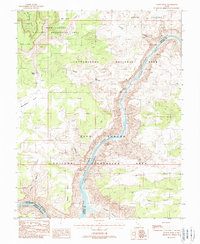
1988 Map of Teapot Rock
USGS Topo · Published 1988About this map
Colorado River carved deep into the desert floor at the junction of Garfield and San Juan counties, creating the dramatic winding corridor of Cataract Canyon. This survey, updated in the late 1980s, documents the interface between the Glen Canyon National Recreation Area and Canyonlands National Park. The arrival of Lake Powell is evident in the southern reaches, where the river widens near Bowdie Point. High above the river, the landscape transitions into distinct tablelands like Waterhole Flat and the intricate drainage systems of Teapot Canyon. The map reveals a land defined by its verticality and isolation, where landmarks such as Teapot Rock and Lands End provide essential orientation in a labyrinth of red rock and dry valleys. Significant topographical features like Imperial Valley and Bull Valley are accessible only via sparse 4wd tracks, underscoring the area's enduring status as one of the most challenging environments in the American West.
Find a feature on this map
24 named features on this map. Tap any name to fly to it.
Don’t see what you’re looking for? This feature index may not catch every label — zoom into the map to look around manually.
Map Details
Editions of this 1988 Teapot Rock Map
2 editions found
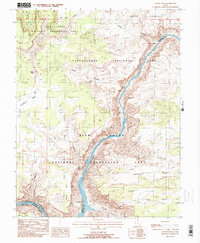
Other maps of this area
1885 · San Rafael
USGS Topo · 1:250,000
1885 · La Sal
USGS Topo · 1:250,000
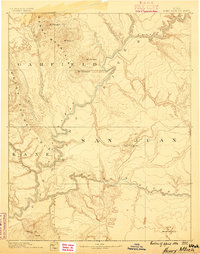
1886 · Henry Mountains
USGS Topo · 1:250,000
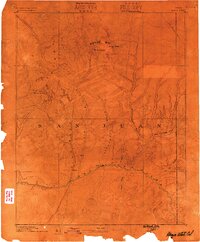
1886 · Abajo
USGS Topo · 1:250,000
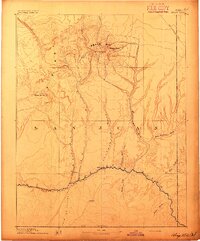
1892 · Abajo
USGS Topo · 1:250,000
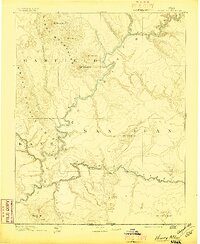
1892 · Henry Mountains
USGS Topo · 1:250,000
1893 · Abajo
USGS Topo · 1:250,000
1935 · Elk Ridge
USGS Topo · 1:96,000
1940 · Elk Ridge
USGS Topo · 1:125,000
1952 · Mouth of Dark Canyon
USGS Topo · 1:62,500