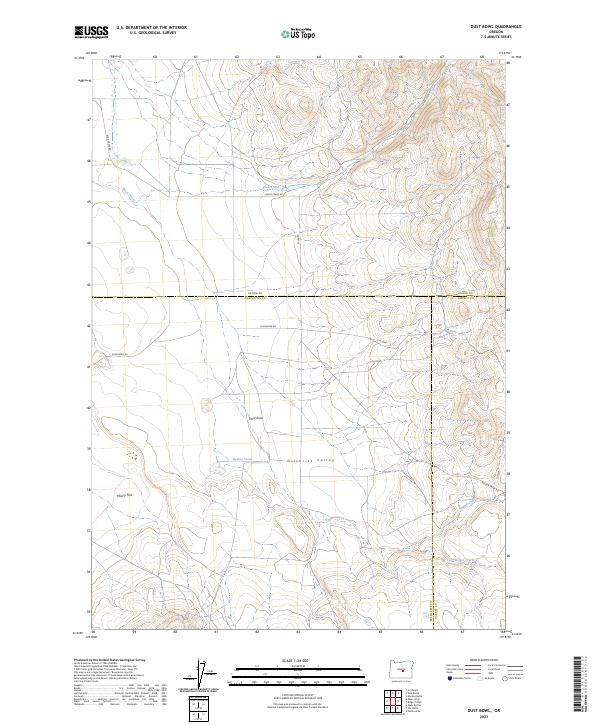
2023 Map of Dust Bowl
USGS Topo · Published 2023About this map
Gilchrist Valley serves as the topographic centerpiece of this high desert landscape where the borders of Crook, Deschutes, and Harney counties converge. The terrain is defined by a series of evocative place names that speak to the challenges of the local environment, most notably the Dust Bowl and Misery Flat. These areas are drained by seasonal watercourses such as Swamp Creek and Buck Creek, which carve through the high-elevation flats. The road network is sparse, consisting of rural connectors like Allen Rd and Schraeder Rd that provide access to remote outposts and water sources like Juniper Spring. The map documents the precise surveyed boundaries between multiple townships, reflecting the systematic division of this arid interior region of Oregon.
Find a feature on this map
19 named features on this map. Tap any name to fly to it.
Don’t see what you’re looking for? This feature index may not catch every label — zoom into the map to look around manually.
Map Details
Editions of this 2023 Dust Bowl Map
This is the sole edition of this map. No revisions or reprints were ever made.
Other maps of this area
1955 · Crescent
USGS Topo · 1:250,000
1955 · Burns
USGS Topo · 1:250,000
1957 · Crescent
USGS Topo · 1:250,000
1958 · Crescent
USGS Topo · 1:250,000
1958 · Burns
USGS Topo · 1:250,000
1959 · Burns
USGS Topo · 1:250,000
1970 · Crescent
USGS Topo · 1:250,000
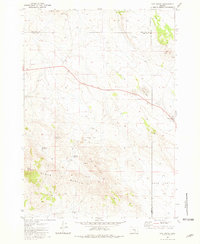
1981 · Hat Butte
USGS Topo · 1:24,000
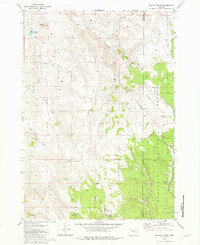
1981 · Mackey Butte
USGS Topo · 1:24,000
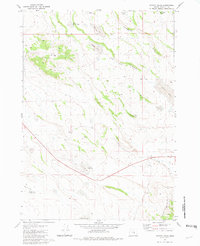
1981 · Potato Hills
USGS Topo · 1:24,000