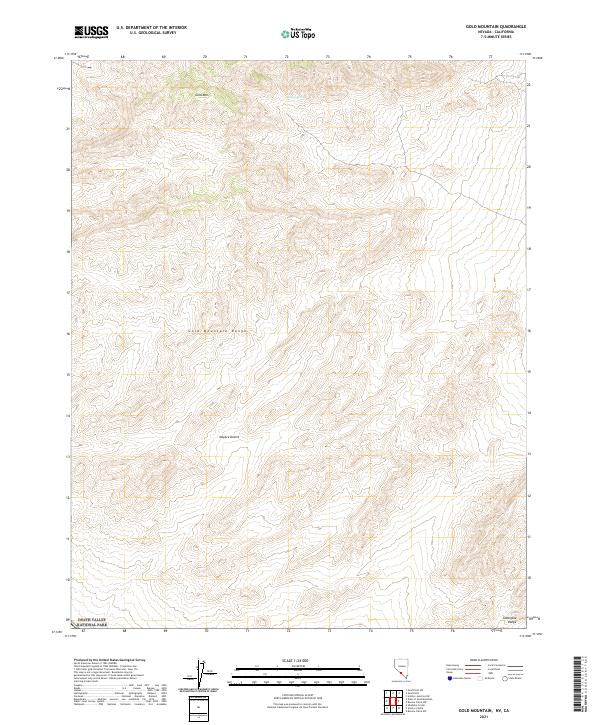
2021 Map of Gold Mountain
USGS Topo · Published 2021About this map
Death Valley National Park extends its boundaries into this portion of the Mojave Desert, where the landscape is defined by the sharp elevations of the Gold Mountain Range. The topography is dominated by the summit of Gold Mtn, a prominent landmark that rises above the surrounding arid terrain. In a region of sparse water resources, Willow Spring appears as a critical natural feature tucked within the high ridges. To the southeast, the terrain transitions into the rugged foothills of the Amargosa Range, illustrating the complex geological intersections that characterize this section of the Nevada-California borderlands. The map reveals the intricate drainage patterns and steep contours typical of the Great Basin's high desert environments, providing a clear view of the wilderness as it appeared during the 2021 survey.
Find a feature on this map
10 named features on this map. Tap any name to fly to it.
Don’t see what you’re looking for? This feature index may not catch every label — zoom into the map to look around manually.
Map Details
Editions of this 2021 Gold Mountain Map
This is the sole edition of this map. No revisions or reprints were ever made.
Other maps of this area
1908 · Lida
USGS Topo · 1:250,000
1913 · Lida
USGS Topo · 1:250,000
1954 · Goldfield
USGS Topo · 1:250,000
1955 · Goldfield
USGS Topo · 1:250,000
1957 · Ubehebe Crater
USGS Topo · 1:62,500
1958 · Goldfield
USGS Topo · 1:250,000
1962 · Goldfield
USGS Topo · 1:250,000
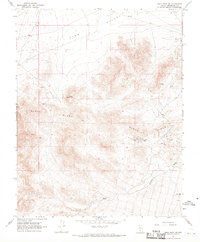
1968 · Gold Point SW
USGS Topo · 1:24,000
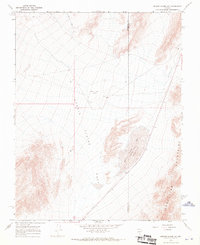
1968 · Bonnie Claire NW
USGS Topo · 1:24,000
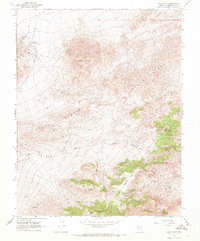
1968 · Gold Point
USGS Topo · 1:24,000