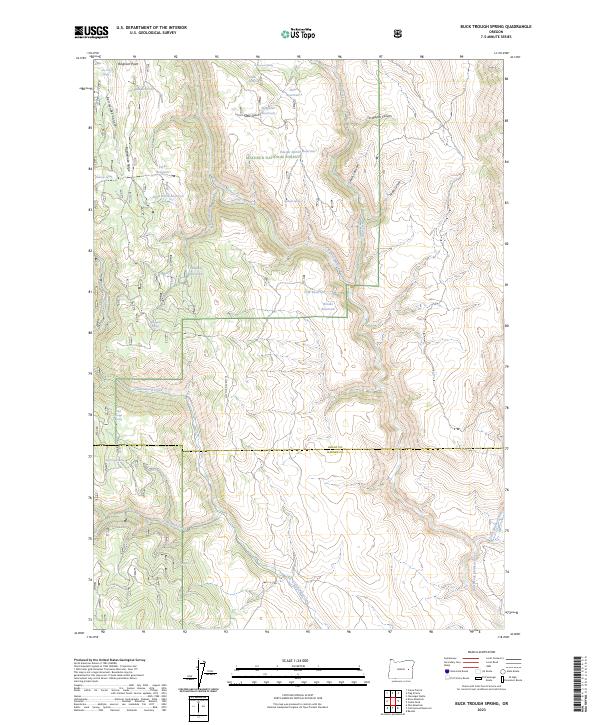
2023 Map of Buck Trough Spring
USGS Topo · Published 2023About this map
Malheur National Forest dominates this section of eastern Oregon, where the headwaters of the North Fork Malheur River and the Little Malheur River carve through the high-elevation landscape. The terrain is defined by a dense network of upland springs and small-scale water management features, including isolated pools like Dead Horse Reservoir, Skagway Reservoir, and Slate Reservoir. These features, along with names like Tin Wagon Canyon and Rattlesnake Ridge, point to a legacy of ranching and resource management in the high desert. The map also documents the boundary between Grant and Harney counties, showing how early political lines follow the topographic height of land. Water sources such as Buck Trough Spring and Red Trough Spring appear as critical landmarks for navigation and land use in this remote forest environment.
Find a feature on this map
38 named features on this map. Tap any name to fly to it.
Don’t see what you’re looking for? This feature index may not catch every label — zoom into the map to look around manually.
Map Details
Editions of this 2023 Buck Trough Spring Map
This is the sole edition of this map. No revisions or reprints were ever made.
Other maps of this area
1908 · Ironside Mountain
USGS Topo · 1:125,000
1955 · Burns
USGS Topo · 1:250,000
1955 · Canyon City
USGS Topo · 1:250,000
1958 · Burns
USGS Topo · 1:250,000
1959 · Burns
USGS Topo · 1:250,000
1959 · Canyon City
USGS Topo · 1:250,000
1966 · Beulah
USGS Topo · 1:62,500
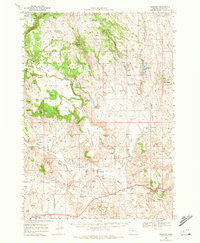
1968 · Drewsey
USGS Topo · 1:62,500
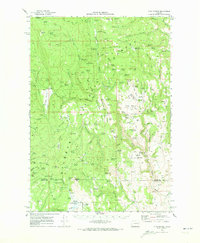
1970 · Flag Prairie
USGS Topo · 1:62,500
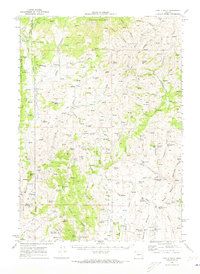
1970 · Castle Rock
USGS Topo · 1:62,500